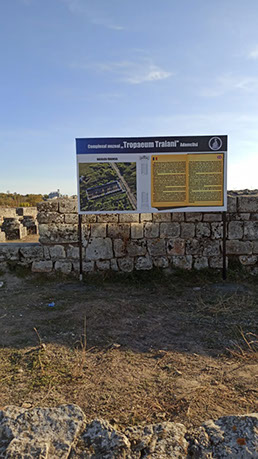



ADAMCLISI MUSEUM COMPLEX - TRAIANI TROPAEUM
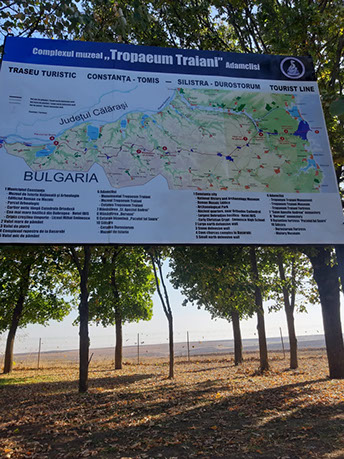
On the national road DN3 Constanța-Ostrov you can reach the commune of Adamclisi (Constanța county) where the fortress and the triumphal monument at Tropaeum Traiani are located, the road distance between Constanța and Adamclisi totaling approximately 63 km.
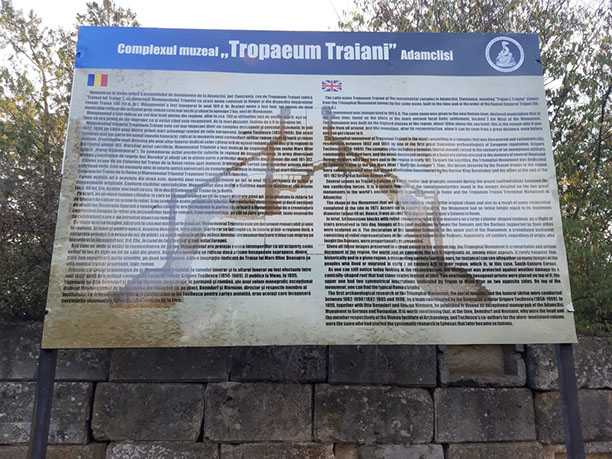
The triumphal monument, the fortress and the museum in the center of the town represent one of the largest and most important archaeological and museum complexes in Romania.
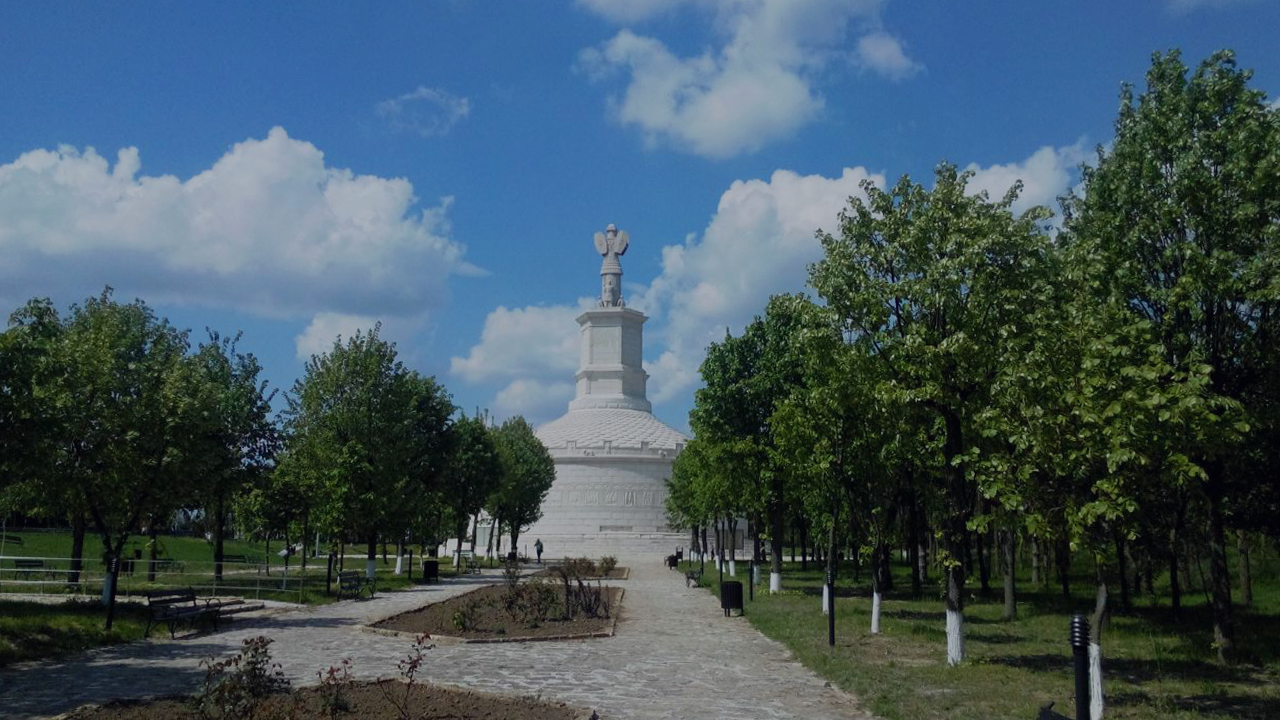
The triumphal monument Tropaeum Traiani
Northeast of the village, approximately 1.5 km on the side road that starts from DN3 east of the village, a triumphal monument can be found. Its location is not chosen by chance, dominating the surrounding relief for tens of kilometers, at approx. 150 m above sea level. The monument, like many of the creations of antiquity, served to impress the local population and transmit an important message (with a precise social function), representing a symbol of Rome, celebrating Rome's victory and its perpetuity.
Both the character of the scenes on the monument, as well as the comparison with other monuments of the same character, more or less contemporary, and especially with Trajan's Column, allowed the understanding of the fact that it does not represent a "campaign diary", but represents an artistic manifestation put at the service of imperial propaganda. Images of the battles fought in Dobrogea also appear on Trajan's Column in Rome, and the two monuments complement each other, in a unique example of complementarity in images, unique in universal ancient history.
Grigore Tocilescu, the director of the National Museum of Antiquities, Grigore Tocilescu began systematic excavations at the Triumphal Monument in 1882, continuing them until 1890. The results of the excavations enjoyed a competent publication in Vienna by the eminent Romanian historian, archaeologist and epigrapher. After completing the research at the altar, the triumphal monument and the funerary tumulus on the Monument Hill, in 1891, Grigore Tocilescu began archaeological work at the Adamclisi fortress.
In its original image, the monument would have appeared as a huge cylinder, topped by a truncated cone, covered with stone slabs in the shape of fish scales, and above it were two hexagonal prisms of different sizes. The latter served as a base for the statue symbolizing military victories – Tropaeum-. The entire monument had a height and a diameter of 40 meters.
Around the monument we identify nine rows of circular steps, a massive cylinder (stereobatum) covered by six rows of polished stone blocks that make up a paramentum, a sculptural complex formed by three rows of overlapping ornamental elements, namely the lower frieze, a succession of metopes framed by pilasters and the upper frieze. The lower one presents a vegetal decoration, in the form of vines with acanthus leaves in volutes, closing in the middle with a wolf's head. Above and below the acanthus volutes are two bands formed by some small protrusions (ovules) and others more elongated in the form of lenticules that alternate regularly. Between the upper band and the volutes, birds appear on some blocks of the lower frieze.

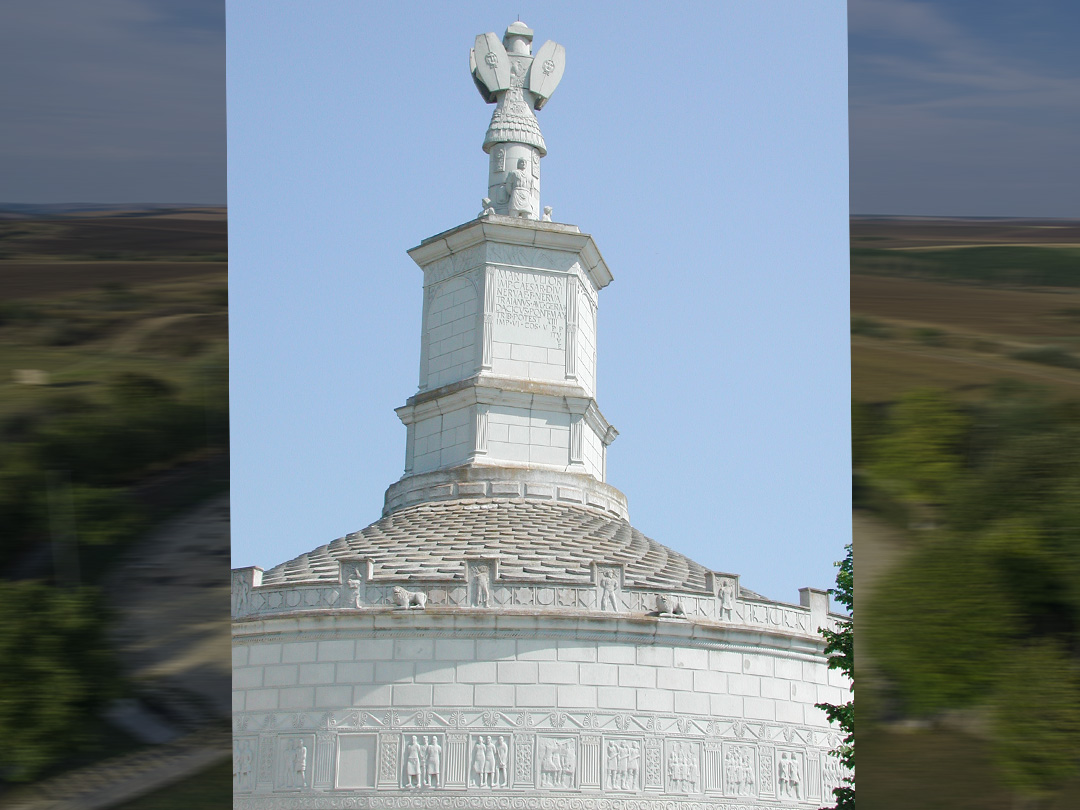
The second component of the complex consists of metopes that are arranged in a circular suite. These are massive stone blocks in the shape of rectangular prisms, with the outer surfaces depicted with valuable scenes inspired by the Dacian-Roman battles. They are of inestimable importance for the reconstruction of valuable historical passages for the Istro-Pontic territory from the end of the 1st century and the beginning of the 2nd century AD. The arrangement of the metopes seems to respect a certain order given by the "narration" of events that took place on the Lower Danube. Thus, the first 27 metopes present the history of a first battle fought in the southern plains of Dobruja in the form of three scenes, namely: the attack and the cavalry fight, then the battle around the chariots and the final worship of the civilian population and the prisoners who came before Emperor Trajan. The next series of metopes are also grouped in three scenes, namely the march to the great battle, the great battle and the acclamation. These events took place at Adamclisi, the finale representing Trajan's review of the Roman troops. Initially, there were a total of 54 metopes (grouped in six scenes of nine pieces each), which unfortunately have not been preserved to this day in their entirety). They were separated by pilasters that were executed in two versions: some with vertical grooves and others with vines, maintaining an equal alternation as a form of manifestation. Representations include Roman horsemen in armor (plates, helmets, mail, oval shields) and armed with lances, aspects from the course of battles, the "barbarian" allies (with clothes and details specific to their ethnic origin). The Roman army is always depicted as superior to the enemy, both as soldiers (including standard bearers and musical instrumentalists), as well as officers, then dignitaries and even Emperor Trajan (he appears dressed in a tunic and cape (paenula), respectively with a Greek breastplate and sometimes holds in one hand the commander's baton or a scroll with military data) in several poses regarding the organization of attacks or councils of trust. Last but not least, elements of the wealth of the Dobrudja region and elements of clothing of the local population are iconographically rendered. The monument's cornice is made up of stone blocks with a twisted rope decoration. Above it were mounted battlements (with a relief representation of prisoners leaning against trees and with their hands tied) and parapet blocks (the scapular attic).
The roof is truncated conical in shape and is composed of 1000 stone slabs, made in the form of fish scales, arranged in 19 or 20 overlapping rows. They are of different sizes, decreasing as the roof rises towards the two overlapping hexagonal bases. Both constitute a solid support for the colossal trophy at the top of the monument. At the top base, an inscription in Latin appears on the north and south, which has been reconstructed as follows: "To the god Mars the avenger, emperor Caesar, son of the divine Nerva, Nerva Trajan, the Augustus, conqueror of the Germans, of the Dacians, high priest, having the power of tribune of the plebs for the 13th time, proclaimed imperator by the army for the 6th time, elected consul for the 5th time, father of the fatherland after defeating the army of the Dacians and the Sarmatians...". Also in this upper part of the monument, above the pilasters of the upper hexagonal base, we also identify a frieze where spears, javelins, curved swords, bows with arrows are depicted (the weapons captured by the Roman army from the enemies). Above the frieze follows another cornice, then the base is built, which is placed on a hexagonal base.
The trophy statue is made up of five overlapping drums up to a height of 4 meters, to which is added the trophy itself which is also 5 meters high. This expresses opulence and massiveness, defining elements of Roman imperial authority. The male character of the trophy is dressed in a suit and armed with Roman military equipment, accompanied by breastplates (initially there were also spears) on which the face of Medusa is printed, and in the center of the cuirass we find a large acanthus flower, a galloping cavalryman, an eagle or aquila with spread wings and a sheathed sword. The equipment includes a lorica towards the bottom, respectively two cnemidae. Three captives also appear at the feet of the character (two women in a sitting position and a man standing with his hands tied behind his back). The respective presences symbolize the submission of the local population following the battles fought in the province of Moesia Inferior, which is also the subject of the event commemorated by the erection of the triumphal monument. But the Trophy itself also had the value of a cenotaph, having a profound funerary significance. And its shape is an indication in this sense.
The triumphal monument from Adamclisi is one of the most significant monuments of Roman provincial art, not only on the territory of Romania, but also on the entire expanse of the ancient Roman imperial world. Its importance is multiple. Once from a historical point of view, as it is one of the few sources regarding the wars of the Romans with the Geto-Dacians, the second time from an artistic point of view, as it constitutes a true milestone in the development of provincial art, and the third time from a national point of view, constituting for the Romanian people one of the irrefutable testimonies regarding the existence of Roman life on the Lower Danube.


The altar and the mausoleum
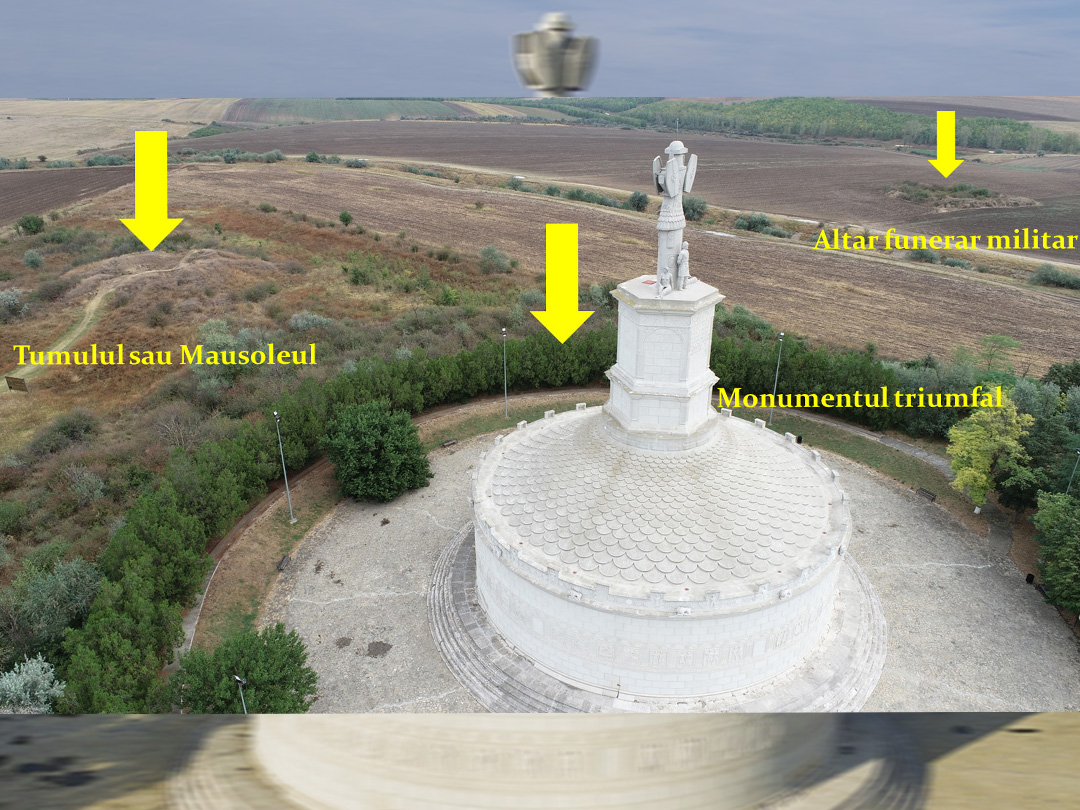
On the same plateau, 250 m west-northwest of the monument, there is the funeral altar dedicated to the approximately 3,800 Roman soldiers who fell on the battlefield. It is made in the form of a base that is built in steps, with a prismatic shape and which was covered with a roof made of tiles and stone. The pilasters framed vast surfaces where the names and ranks of the Roman combatants were printed, grouped even by the component units (and as members of some combat units, praetorians, legionaries, missii, auxiliaries are mentioned). Fragments of the frieze, architrave and pilasters (vegetable candelabra, a garland, a vine) have also been preserved from the ornamentation. There is also a dedicatory inscription: "In memoriam fortissimorum virorum qui pugnantes pro republica, bello dacico, morte accubuerunt" (in memory of the very brave men who, fighting for the homeland, in the war with the Dacians, lay down in death). The Roman general who fell in the military confrontation seems to have resided in Neapolis.
Approximately 100 meters from the monument there is an earthen mound (2.50 m high and with a diameter of approximately 20 m) inside which specialized archaeological excavations revealed the presence of stone and wood infrastructures that would have belonged to a mausoleum. The stone construction was square in shape and rested on a solid base formed by six stone steps. Four concentric rings made of stone and mortar in different ways were identified, the first of which is made in the opus quadratum technique, and three in opus coementicium. The funerary construction has a tomb (tumulus) in the central area, probably belonging to an important Roman officer, where there should have been a cremation urn with the remains of that praefectus castrorum. Architectural fragments and stone slabs on which Latin inscriptions were engraved were also recovered.
The two monuments were erected after the battle or in 102 AD. They preceded the trophy which was built between 106-109 (between 10 December 108 and 10 December 109).
During the restoration works of the Triumphal Monument from before 1977, archaeological research was resumed at the other two monuments in the immediate vicinity, the tumulus tomb of an unidentified military commander and the funerary altar dedicated to the several thousand Roman legionaries who fell in battle.
The Fortress
The fortress of Tropaeum Traiani (comm. Adamclisi, Constanța county), in all its current complexity, represents a historical, archaeological and touristic objective of prime importance in the ensemble of Roman-era sites in the eastern part of the Roman Empire. Located in the southwestern part of the village of Adamclisi, on the plateau of the Urluia valley, it is one of the most important economic, political and religious centers in Roman Dobrogea and in the eastern part of the Empire (within the provinces of Moesia Inferior and Scythia), the specialized research carried out for more than 120 years revealing a large amount of historical, archaeological and architectural information, disseminated in scientific and popularization works.
The systematic archaeological research at Tropaeum Traiani, which began with Grigore Tocilescu in 1891 (through 12 campaigns in the years: 1891-1893, 1895-1897, 1904-1909), had as major objectives the establishment of the plan and character of the fortress, the unveiling of the monuments (gates, enclosure, etc.), the establishment of the topography and street layout belonging to the late Roman and early Byzantine city, the research of the Christian basilicas, of the component neighborhoods of the city. The research was continued in 1910-1911 by George Murnu (who continued the unveiling of the road between the two main gates, on the decumanus maximus), then in the interwar period by Paul Nicorescu (with the unveiling of the enclosure, along it, to which are added the first attempts to bring to light the walls of the annex fortification in the southeast area of the fortress), and in 1947, after the Second World War, Gheorghe Ştefan and Ion Barnea carried out a stratigraphic survey between the east gate and the northeast corner of the fortress. Systematic investigations were resumed in 1968, by a team of researchers from the "Vasile Pârvan" Institute of Archaeology in Bucharest, the Museum of National History in Constanţa, the Institute of Archaeology and History of Art in Cluj and the Institute of Archaeology in Iaşi, under the leadership of Ion Barnea, emeritus specialist in paleochristian art. A specialist in ancient history and classical archaeology and Greek and Latin epigraphy, Professor Alexandru Barnea covered, through his concerns, a diverse thematic area. Starting with 1978, the management of the site fell to Alexandru Barnea, a specialist in ancient history and classical archaeology and Greek and Latin epigraphy, and the archaeological research at Adamclisi focused on the basilica forensis, the marble basilica, the basilica cistern, the basilica with transept and the cemetery basilica on the hill in the north of the fortress, the research of the neighborhood south of basilica D, the southern neighborhood and the northward extension of the research of the neighborhood in sector A.

It was built on the orders of Emperor Trajan for the families of veterans who participated in the Dacian wars. Before the construction of the Roman center, on the site, according to archaeological discoveries, there was a Getic settlement, which can be located today in the central area of the Roman fortress, at the highest point on the plateau. The new fortification evolves demographically through its constant population with various elements of Roman and Greek origin. Already, before the year 170, there is a flourishing urban center, raised under Emperor Marcus Aurelius to the rank of municipium, led by a senate and benefiting from numerous magistrates, respectively a body of priests of the official cult.
The city was rebuilt from the ground up at the beginning of the 4th century AD, according to an inscription dated 316 AD, by Emperor Constantine the Great. The previous destruction caused by the Goths was removed by providing new massive defensive walls. The current enclosure wall has several construction phases, namely: a pre-Constantinian phase from the end of the 3rd century AD and a Constantinian one that follows the irregular shape of the plateau, having a thickness of 2.60-3.70 m and a length of approx. 1200 m. Two U-shaped towers bordered the two main gates (east and west), which also marked the ends of the axial street (via principalis). The west gate had a massive arch-shaped vault (with a width of 4.40 m). The eastern gate had a system of closing the wings, fixed with an iron bar (4 m wide). Two other gates, the northern and southern, were framed by massive quadrangular bastions. All the gates, but especially the western one, ensured the connection with the imperial road that crossed Roman Dobrogea from north to south. The city had running water and sewage systems, as well as public baths. A fortified annex was added to the SE in the second half of the 4th century. The via principalis, oriented east-west, was 300 m long and 14 m wide, was paved with large stone slabs and had a 7 m wide roadway, with porticos on the sides for pedestrian traffic. In the central part of the street there is a rainwater collector channel, inside which the copper pipe for transporting drinking water is preserved.
A final period of development is recorded from the end of the 5th century until the second half of the 6th century, when the fortress becomes, in addition to an important civic center, an important religious center. Proof of the religious role played as an episcopal center in Dobrogea is the multitude of basilicas built in the fortress, five inside and two outside. The latter are built on the plateau in the northern part of the fortress, not far from the western gate. The first had two phases of operation (cemetery and then parish). The second basilica functioned in the second half of the 4th century as a cemetery church, and from the second half of the same century and especially towards the end of the 5th century it becomes a parish church. Inside the fortress, the five basilicas are the "marble" one, cistern, forensis, with transept and A or simple.
The severe destruction of the Tropaeum fortress was due to the Avar-Slavic invasion of 586 AD, a fact attested by all the archaeological excavations carried out inside the fortification, a situation corresponding to a massive quasi-final layer affected by fire. The same attack also affected other important centers of the time such as Ratiaria, Durostorum, Zaldapa, Markianopolis, etc., as literary and archaeological sources tell us. Some extremely dispersed and weak elements of life seem to continue in the fortress in the 7th century, but the fortress loses its urban character. From an archaeological point of view, the first discreet indications of a possible "repopulation" of some sectors inside the former city (especially near the north and south gates, respectively along the southwest enclosure) or the immediate surroundings, belong to the 10th-11th centuries, specific to the early Middle Ages. Evidence of the existence of an early medieval settlement near the Roman-Byzantine fortress consists in the detection of specific ceramic fragments on the slopes that delimit its plateau. A possible necropolis near the fortress is suggested by the fortuitous discovery, over three decades ago, of an inhumation tomb, on a private property within the urban area of the Adamclisi locality, located approximately 1.5 km in a straight line from the southern side of the Roman-Byzantine enclosure. The early medieval materials in the fortress area belong to the 10th century and the first decades of the 11th century AD.
In recent decades, several points inside the fortress have been and are being researched, by sectors, corresponding to representative objectives for the history of the ancient city. The broad context in which these researches are part is represented by provincial Roman archaeology, having as its major objective the knowledge of the monuments, topography and street layout belonging to the late Roman city. Along with the research of the Christian basilicas, the site in recent years, under the direction of Gabriel Talmațchi since 2020, has been subjected to specialized investigations carried out on civil architectural structures in different sectors of the fortress.


Adamclisi Museum
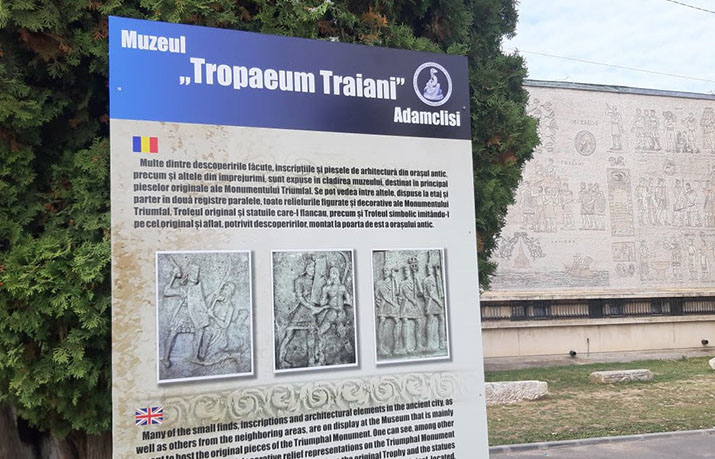
The building, in the center of Adamclisi, was inaugurated in 1977, in the presence of President Nicolae Ceaușescu, and contains archaeological remains discovered as a result of archaeological research and fortuitous discoveries in the Tropaeum Traiani fortress, at the monument (the original pieces) and in the immediate or more distant vicinity. There are ceramic collections, collections of architectural pieces, collections of ornaments, etc. Also on display are metopes, the lower and upper frieze, pilasters, battlements and parapet blocks of the festooned attic, the colossal statue of the trophy, the inscription and frieze with weapons, remains of the walls of the cenotaph altar, fragments of the pedestal of the trophy statue on which the face of Medusa and the Cnemides are carved, a scale support, a scale from the truncated roof. We continue with the 48 original metopes (out of the 54 that once existed) in an order consistent with the unfolding of events in the winter of 101-102 BC. We also list as present a rich epigraphic material (as evidenced by the inscription on the statue's pedestal regarding the mention in 116 of the inhabitants Traianenses Tropaienses), the dedicatory inscription coming from the triumphal monument, funerary stelae (reused over time as construction materials) among which stands out that of L. Fufidius Lucianus whose function within the city administration betrays its declaration in 170 AD. as a municipium or others that recall the presence of veterans from Legio V Macedonica or mentions of merchants from Syria, Palestine, Greece, etc., bas-reliefs (with representations of a tropaeum, of Thanatos), fragments of aqueducts, capitals with imposts, other architectural fragments, Roman ceramics of common or luxury use, tools, objects of adornment (rings with gems, brooches, appliques, bells), keys, etc. Last but not least, we note the presence of a particularly small trophy that reproduces on a much smaller scale the colossal statue/trophy that was discovered at the eastern gate of the fortress, a true emblem of the city in the first half of the 4th century AD.
Two years ago, the museum's exhibition was modernized, being enriched with explanatory panels regarding the main monuments discovered in the fortress and with new pieces discovered in the last two decades during archaeological research.
Gallery
-
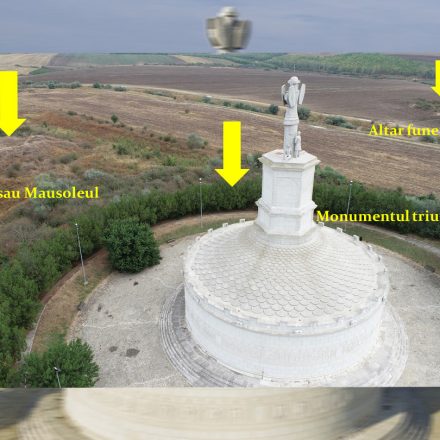
- Aerial view of the Military Funerary Altar, Tumulus or Mausoleum, Triumphal Monument at Adamclisi
-

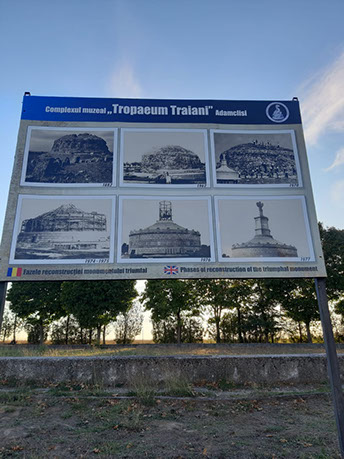
- The core of the monument before restoration
-

- Exterior al Muzeului din localitate