



Brief history of archaeological research at Ovidiu
Systematic archaeological excavations at Ovidiu began in 1979 and were carried out over 20 campaigns, the last one being carried out in 2008. In 2020, an extensive preventive research campaign was carried out prior to the restoration project, which allowed the unveiling of all the structures visible today.
During the period 2012-2022, numerous preventive researches were also carried out in the area surrounding the fortification, identifying several sections of the underground aqueduct, as well as consistent traces of habitation from the Hellenistic and early Roman periods.
The research was coordinated by archaeologists Mihai Bucovală (period 1979-1999), Gheorghe Papuc (between 2000-2008) and Constantin Băjenaru (between 2012-2022). The archaeological excavations were carried out mostly with young workers from Ovidiu, and after 1993 with several generations of students from the "Ovidius" University in Constanța.
General chronological table of the archaeological site of Ovidiu
Period A – Greek and Hellenistic era (6th-2nd century BC) – Getic settlement, with numerous imports from the Greek environment; the intensity of habitation during this period, especially in the Hellenistic period (3rd-2nd century BC), was confirmed by a series of recent preventive research in the area west of the fortification.
Period B – the early Roman era (2nd-3rd centuries AD) – begins with the construction of the aqueduct that supplied the city of Tomis (most likely during the reign of Emperors Hadrian or Antoninus Pius); residential nuclei have been identified that were probably related to its construction, guarding and maintenance;
Period C – late Roman era (5th century AD) – intense habitation developing around a small paleochristian basilica; the character of this place is more difficult to discern, but a possible monastic community can be postulated.
Period D – early Byzantine era (6th century AD) – corresponds to the construction of the fortification type quadriburgium and the preservation of the basilica in the extramuros area; at the earliest, the fortification could date back to the period of Anastasius (491-518), but it is more likely a work of the program of fortification of the Balkan-Danubian area from the period of Justinian (527-565);
Period E – early medieval period (10th century AD) – attested by isolated ceramic fragments indicating the beginning of a systematic process of dismantling and extracting stone from the fortification walls.
Fortification
The Ovidiu fortification is classified in the category quadriburgium, a modern term denoting a minor fortification with four corner towers. Recent studies have shown that this type of fortification was very widespread in the late Roman era, being found especially on the borders or along the important roads of the Empire. Based on architectural details (including the thickening for the access staircase, the entrances to the towers in the form of a corridor and the positioning of the main entrance), corroborated with information from archaeological research (stratigraphy), the fortification at Ovidiu belongs to the early Byzantine type, developed in the Balkan provinces of the late Empire in the first half of the 6th century AD.
The fortification is rectangular in shape, covering an interior area of approximately 53 x 41 m. The foundations are approximately 3 m wide, and the first elevations are built in the parament and emplecton system. The first parament is generally made up of very large limestone blocks (which form the base - crepid), except for the eastern curtain wall where medium blocks were used. Due to the pronounced dismantling, no clear evidence has been preserved for the construction technique of the elevation above the first two preserved stone assizes, but a construction in opus mixtum (stone assizes alternating with assizes composed of 5 rows of bricks) based on analogies with other fortifications built in the same era and brick fragments identified in the rubble.
Stratigraphic observations and those based on construction techniques show us that before the construction of the current fortification there was an attempt to fortify the site placed closer to the ancient bay. At some point this was abandoned at the foundation stage to make way for the new fortification placed further west, but which will retain for its eastern enclosure the foundation that in the initial attempt was supposed to support an enclosure with the front facing west. Of this initial fortification, the entire western front is preserved (including a thickening on the inside for the access staircase), two circular towers at the corners and two monolith towers in the central area, the latter very poorly preserved.


Early Christian basilica
The building was first identified in the 1998 campaign and fully investigated in the following years (1999, 2002, 2003, 2007). The basilica's plan consists of a vestibule (most likely with a role of narthex), a single nave with four massive pilasters on the inside and an apse on three sides. The exterior dimensions of the building itself are 17 x 8.5 m, and if the vestibule is added, it reaches 20.5 x 8.5 m.
The walls are built on a stone foundation bound with mortar and have an elevation of opus mixtum or even entirely made of brick. Unfortunately, the action of the water led to the total destruction of the elevation in the eastern portion. The apse is also built on unstable ground (probably on the shore of the ancient bay) and therefore has a base made of massive limestone blocks.
The construction technique denotes two phases of the evolution of the building, especially regarding the vestibule. In a first phase, L-shaped pilasters (built entirely of brick) are placed at the corners, and there is a brick pavement inside. In the second phase, the north and south sides (which must have been originally made of wood or other light materials) are blocked by walls of earth-bound stone, without a foundation, with the first assize placed directly on the brick pavement. Also, two gigantic limestone blocks (carved at the ends to form a kind of architrave) are arranged on either side of the entrance on the west side, it being possible that in the initial phase they were placed above the openings on the north and south sides.
Chronologically, there is stratigraphic evidence to date the construction of the basilica to the middle or second half of the 5th century. The building continued to be in use throughout the 6th century (being positioned outside the newly built fortification) and was abandoned at the same time as the fortification, sometime between 580 and 600.
Gallery


-

- default

-

- default

-

- default


-
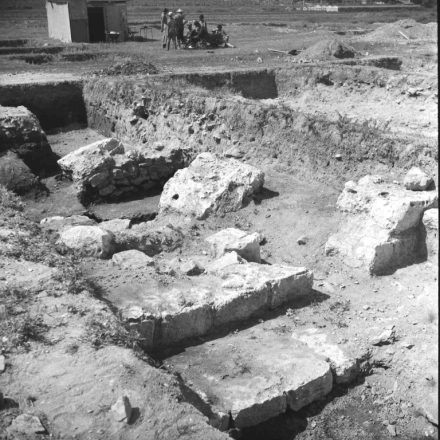
- Image from the construction site in 1984
-
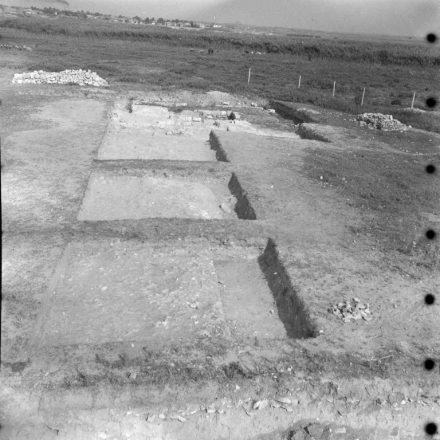
- Image from the construction site in 1982
-
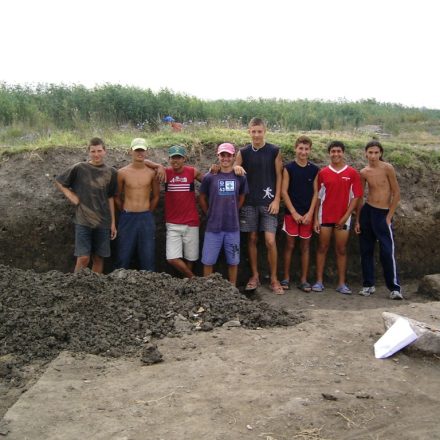
- DIGITAL CAMERA


