INTERNATIONAL SCIENTIFIC COMMUNICATIONS SESSION PONTICA
ORGANIZATION

INVITATION
Dear colleagues,
Between September 25–27, 2024, the Constanța Museum of National History and Archaeology, the Center for Studies of Black Sea Civilizations and the Faculty of History and Political Sciences of the "Ovidius" University of Constanța, with the support of the Constanța County Council and in partnership with the Faculty of History of the University of Bucharest, the Faculty of History and Art Theory of the National University of Arts of Bucharest, the Numismatic Cabinet of the Library of the Romanian Academy, the "Vasile Pârvan" Institute of Archaeology of the Romanian Academy, the National Institute of Heritage in Bucharest, the Institute for Black Sea Studies of the "Ovidius" University of Constanța, the "Gheorghe Șincai" Institute for Socio-Human Research in Târgu Mureș, the Institute for the Study of National Minorities Problems in Cluj-Napoca and the Institute for the Investigation of the Crimes of Communism and the Memory of Romanian Exile are organizing:
PONTICA International Scientific Session, 57th Edition:
HISTORY AND ARCHAEOLOGY IN THE WEST-PONTIC SPACE.
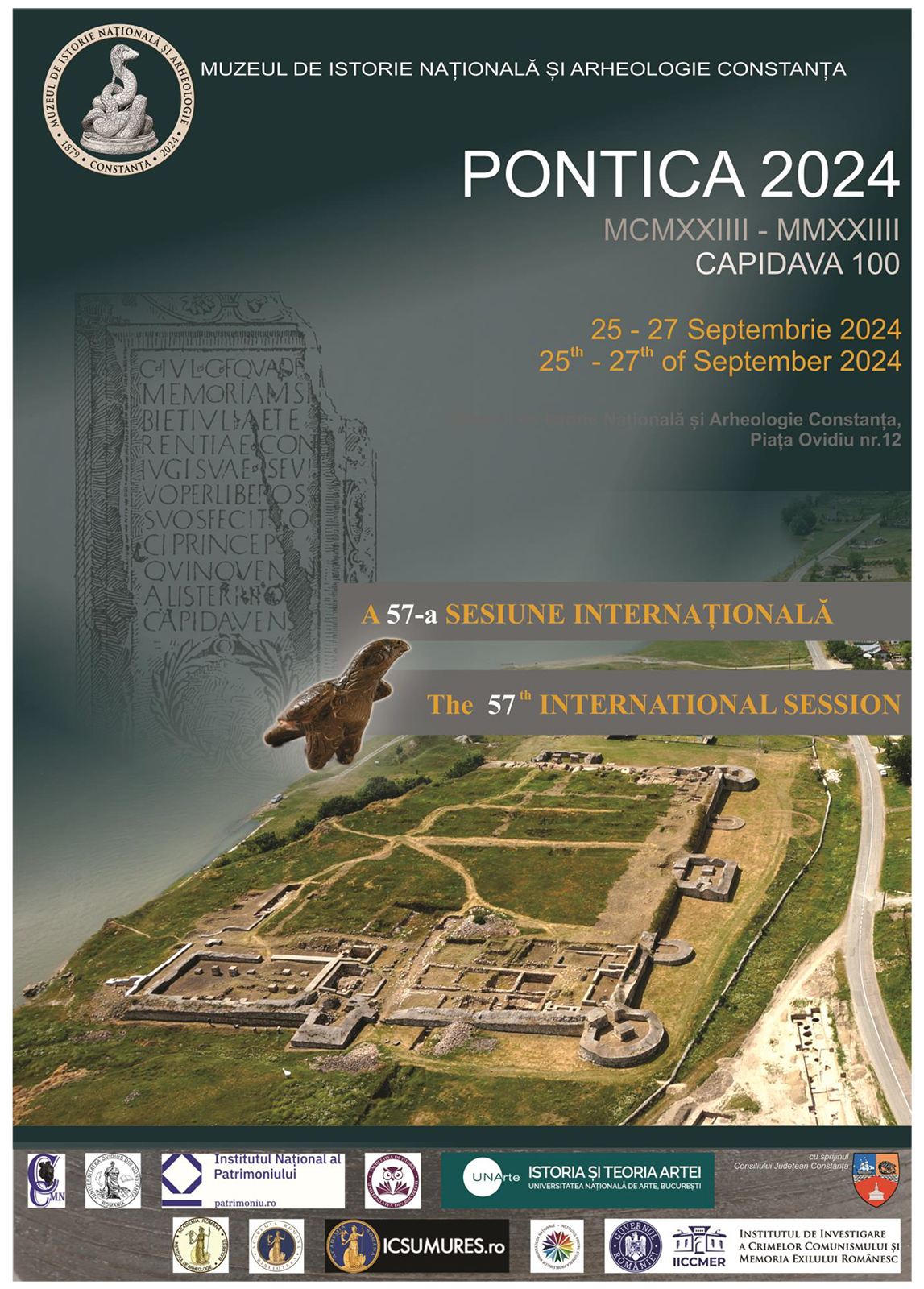
Knowing your concerns, we would be honored if you would participate in the proceedings of this scientific event, which will be held in a mixed format (with physical presence and online). More information about the organization will be posted on the website www.minac.ro and will be sent in due time.
The papers will be presented in the following sections, grouped by fields: Pre-Protohistory, Greco-Roman, Medieval, Modern-Contemporary and Numismatics, as well as in the following thematic sessions: The decline of “Old Europe”: exchanges, symbioses, cultural syntheses; Capidava and the Roman frontier of the Lower Danube (1st–7th centuries AD); Fortresses, cities and settlements. Daily life on the edge of empires (7th–13th centuries); Numismatics in the context of the ancient and medieval worlds of the Lower Danube area; On life and death in Antiquity and the Middle Ages. Coins and daily contexts specific to the living and funerary worlds; Dobrogea – Romanian space (19th–21st centuries); Democracy and totalitarianism: Panel 1 – Ideology and political practice in the interwar period; Panel 2 – Romanian-American relations in the 20th century; Panel 3 – Minorities in Romania: new directions, sources and research methods; Panel 4 – Communism and the Holocaust; Conservation, restoration and museography – current developments and trends.
The attached registration form, also available on the museum website, under the "Sessions" heading, will be sent to the section organizers or to the following address: sesiuneapontica@gmail.com until August 1, 2024.
The museum will provide accommodation and meals for participants, with the proviso that, in the case of communications with multiple co-authors, the free service will be valid for only one participant.
With kind consideration,
Director,
Dr. Aurel Mototolea
SCIENTIFIC COMMITTEE
Dr. AUREL MOTOTOLEA – Director (Museum of National History and Archaeology Constanta), Dr. VALENTINA VOINEA (Museum of National History and Archaeology Constanta), Dr. CRISTIAN EDUARD ȘTEFAN (Institute of Archaeology "Vasile Pârvan"), Dr. CONSTANTIN BĂJENARU (Museum of National History and Archaeology Constanta), Dr. IOAN C. OPRIȘ (Faculty of History, University of Bucharest), Dr. CRISTINA TALMAȚCHI (Museum of National History and Archaeology Constanta), Dr. CONSTANTIN ȘOVA (Museum of National History and Archaeology Constanta), Dr. GABRIEL TALMAȚCHI (Museum of National History and Archaeology Constanta), Dr. EMANUEL PETAC (Numismatic Cabinet, Library of the Romanian Academy), Dr. LAVINIA DUMITRAȘCU (Museum of National History and Archaeology Constanta), Dr. DELIA CORNEA (Museum of National History and Archaeology Constanta), Dr. FLORIN ANGHEL (Faculty of History and Political Sciences, "Ovidius" University Constanta), Dr. EMANUEL PLOPEANU (Faculty of History and Political Sciences, "Ovidius" University Constanta), Dr. ROMEO GHEORGHIȚĂ (Faculty of History and Theory of Art, National University of Arts Bucharest).
ORGANIZING COMMITTEE
Dr. DANIEL CITIRIGĂ (Faculty of History and Political Science, "Ovidius" University Constanta), Dr. GABRIEL MANEA (Faculty of History and Political Science, "Ovidius" University Constanta), Dr. METIN OMER (Institute for Black Sea Studies, "Ovidius" University Constanta), Dr. IRINA SODOLEANU (Museum of National History and Archaeology Constanta), Dr. MARIA BOLOCAN (Museum of National History and Archaeology Constanta), Drd. TIBERIU POTÂRNICHE (Museum of National History and Archaeology Constanta), Drd. OANA GRIGORUȚĂ (Museum of National History and Archaeology Constanta), Drd. ANDREEA ANDREI (Museum of National History and Archaeology Constanta), Drd. MANUELA MĂIȚĂ (Museum of National History and Archaeology Constanta), Drd. ADRIAN IRIMIA (Museum of National History and Archaeology, Constanta), NICOLETA MIVU (Museum of National History and Archaeology, Constanta).
THEMATIC SECTIONS
Thematic section PREHISTORY
The decline of "Old Europe": exchanges, symbioses, cultural syntheses
The Downfall of Old Europe: Exchanges, Symbioses, Cultural Syntheses
Organizers: Valentina Voinea, Cristian Eduard Ștefan
The expansion of archaeological research into sites belonging to previously less well-known historical periods, the scope of preventive excavations and interdisciplinary studies require a reassessment of the cultural phenomena produced at the end of the 5th millennium BC. In this new research framework, the causes that determined the end of Old Europe appear much more complex than initially thought, the hypothesis of the violent penetration of some eastern communities proving to be much too simplistic. Therefore, the organizers of this thematic section propose to submit to debate some of the many possible topics.
Among the topics proposed for debate are: what led to the end of the flourishing Eneolithic communities in the West Pontic littoral and how their disappearance influenced the evolution of neighboring communities; what was the extent of the climatic and geomorphological changes since the end of the 5th millennium BC and what was their impact on the evolution of Eneolithic communities in Old Europe; how intense were the material exchanges between the Eneolithic communities in Old Europe and the Eastern ones; what was the nature of the relations between the communities of Old Europe and the newcomers; how technological innovations and new "ceramic fashions" contributed to the birth of cultural symbioses; and how cultural syntheses manifested themselves in the contact areas between the great Eneolithic complexes and how operable the established notions of "culture" and "phase" remain for these cultural phenomena.
The Downfall of Old Europe: Exchanges, Symbioses, Cultural Syntheses
The expansion of archaeological research into sites belonging to previously less well-known historical periods, together with the scale of preventive excavations and interdisciplinary studies, requires a reassessment of the cultural phenomena that occurred at the end of the 5th millennium BC. Within this new research framework, the causes that led to the end of Old Europe appear far more complex than originally believed, as the hypothesis of a violent intrusion of eastern communities has proven to be overly simplistic. Therefore, the organizers of this thematic section propose to discuss a number of key topics related to these processes.
The proposed topics include: what led to the decline of the flourishing Eneolithic communities along the western Black Sea coast and how their disappearance influenced the development of neighboring communities; the extent of the climatic and geomorphological changes at the end of the 5th millennium BC and their impact on the evolution of Eneolithic communities in Old Europe; the intensity of material exchanges between the Eneolithic communities of Old Europe and those from the East; the nature of the relationships between the communities of Old Europe and the newcomers; the contribution of technological innovations and new ceramic styles to the emergence of cultural symbioses; and the ways in which cultural syntheses developed in the contact zones between the major Eneolithic cultural complexes, as well as the extent to which the traditional concepts of "culture" and "phase" remain applicable to these phenomena.
MEDIEVAL SECTION
Fortresses, Cities and Settlements. Daily Life on the Edge of Empires (7th–13th Centuries)
Fortresses, Towns and Settlements. Everyday Life on the Edge of Empires (7th–13th Centuries)
Organizers: Cristina Talmațchi and Constantin Șova
Due to the late migrations, the 7th–13th centuries represented for Central and Eastern Europe a period marked by territorial changes, accompanied by social, political and economic transformations. On the fringes of the empires, both within and in their vicinity, in fortifications, cities and settlements, daily life presents different characteristics from that within the imperial territories. Raids, conflicts, administrative changes, instability and the influence of the empire on the neighboring territories are just some of the factors that strongly influenced the evolution of these communities. The purpose of the proposed theme is to highlight the way in which daily life unfolded in the proximity of the imperial borders. Papers may address issues such as archaeological evidence and written sources of conflicts in border areas, the change of administrative boundaries and its impact on daily life in old and new settlements, the evolution of a fortification, a city, a settlement or a region located on the edge or in the vicinity of an empire, the analysis of relevant events or the evolution of certain categories of goods, such as ceramics, as well as the relations of these settlements with production centers inside and outside the empire. Other contributions that fall within this general theme are also welcome.
Fortresses, Towns and Settlements. Everyday Life on the Edge of Empires (7th–13th Centuries)
Due to the late migrations, the 7th–13th centuries represented a period of profound territorial, social, political and economic change in Central and Eastern Europe. On the fringes of empires, both within imperial territories and in neighboring regions, life in fortifications, towns and settlements developed characteristics distinct from those found in the imperial core. Raids, conflicts, administrative changes, political instability and the influence exerted by empires on adjacent territories were among the factors that shaped the evolution of these communities. The aim of this thematic section is to explore the changing realities of everyday life in frontier regions. Contributions may address topics such as archaeological evidence and written accounts of conflicts in border areas, the impact of shifting administrative boundaries on daily life in old and newly established settlements, the evolution of fortifications, towns, settlements or wider frontier regions, the study of significant historical events or specific categories of material culture, such as ceramics, as well as the relationships between these settlements and production centres located both inside and outside the empire. Any other contribution relevant to the general theme is welcome.
MODERN – CONTEMPORARY SECTION
Dobrogea – Romanian space (19th-21st centuries)
Dobrogea – Romanian Territory (19th-21st Centuries)
Organizatori / Organizers:
Lavinia Dumitrașcu
Oana Grigoruță
Dobrogea – Romanian space (19th-21st centuries)
Over time, in-depth research has been conducted on the events and people of the 19th-21st centuries, based on documents, memoirs, oral sources, etc., in an attempt to get closer to historical truth. The Romanian space went through numerous events in the 19th-21st centuries, which caused revolutions, wars, unions and disunions, evolutions and involutions, ecstasy and agony, and, again, ecstasy….
History was written by people, more or less important, each with their own joys and dramas. And, regardless of how big or small they were, each one contributed, according to their training and function, at least a grain to the development of the Romanian nation and the country. The Dobrogea – Romanian space in the 19th-21st centuries section aims to take further steps in presenting documents and interpreting the events of this period.
Dobrogea – Romanian Territory (19th-21st Centuries)
About the events and people of the 19th-21st centuries, in-depth research has been done over time, based on documents, memoirs, oral sources, etc., in an attempt to get closer to the historical truth. In the 19th-21st centuries, the Romanian space crossed many events, which caused revolutions, wars, unions and disunions, evolutions and involutions, ecstasy and agony and, again, ecstasy....
History was written by people, more or less important, each with his own joys and dramas. And, regardless of how big or small they were, each one contributed, according to his training and position, at least to a small extent to the development of the Romanian nation and the country. The section Dobrogea – the Romanian space in the 19th – 21st centuries aims to take additional steps in the presentation of documents and in the interpretation of the events of this period.
Democracy and totalitarianism
Democracy and Totalitarianism
Organizatori / Organizers:
Delia Cornea (MINAC), Emanuel Plopeanu
Panel 1
Ideology and political practice in the interwar period
Idelogy and Political Practice in the Interwar Period
Organizator / Organizer:
Adrian-Alexandru Herța
Ideology and political practice in the interwar period se adresează cercetătorilor care studiază regimurile politice din Europa Centrală și de Sud-Est, și care, prin contribuția lor, pot aduce noi abordări legate de sistemul pluripartidist sau regimurile autoritare/dictaturile din regiune.
Idelogy and Political Practice in the Interwar Period is addressed to the historians on political regimes from Central and South-Eastern Europe, whose researches contribute to new approaches concerning multiparty sistem or authoritarian/dictatorship regimes.
Panel 2
Relații româno-americane în secolul al XX-lea
Romanian-American Relations in the 20th Century
Organizator / Organizer:
Daniel Citirigă
Romanian-American relations in the 20th centuryis organized in partnership with the Institute of Socio-Human Research "Gheorghe Șincai" in Târgu-Mureș and aims to approach bilateral relations, both from a political, but also a cultural or educational point of view. In the same context, the exhibition titled will be organized The Americans came. The American Red Cross in Romania after World War I.
Romanian-American Relations in the 20th Century is organized in partnership with "Gheorghe Șincai" Institute for Social Sciences and the Humanities, Târgu-Mureș. It proposes an approach to bilateral relations, from a political point of view, but also cultural and educational. In the same context, the exhibition The Americans Have Come – American Red Cross in Romania after WWI will be organized.
Panel 3
Minorities in Romania: new directions, sources and research methods
Organizator / Organizer:
Metin Omer
Minorities in Romania: new directions, sources and research methods is organized in collaboration with the Institute for the Study of National Minority Issues (ISPMN Cluj – Napoca) and the Institute for Black Sea Studies (UOC). The main objective of this sub-section is to analyze the relationship between minority and majority, both in the democratic period of Romania and in the dictatorial/totalitarian one. We propose approaches related to the representative institutions of minorities, specific legislation, intellectuals, cultural life. At the same time, an exhibition will be organized with the theme Mișcarea Națională Tătară Crimeeană în perioada interbelică.
Minorities in Romania: sources and new research methods, organized in partnership with the Romanian Institute for Research on National Minorities (ISPMN Cluj-Napoca) and The Institute for Black Sea Studies. The main goal of this panel is to analyze the relationship between minority and majority, both in democratic experience and dictatorial/totalitarian. We propose an approach to the main institutions of ethnic minorities, particularly legislation, intellectuals, cultural life. Also, the exhibition Tatar National Movement of Crimea in the Interwar Period will be organized.
.
Panel 4
Communism and the Holocaust
Communism and Holocaust
OrganizatorI / Organizers:
Florin Anghel
Gabriel Stelian Manea
Communism and the Holocaust, in collaboration with the Institute for the Investigation of the Crimes of Communism and the Memory of Romanian Exile (IICCMER), aims to analyze the criminal nature of the Legionary, Antonescu and Communist regimes. In this regard, proposals for communications will be selected that will address theoretical analyses of the regimes in question, political biographies of those involved, victims or active supporters, historiographical approaches, causal relationships and effects of the establishment of these regimes, places of memory.
Communism and Holocaust, organized in partenership with The Institute for the Investigation of Communist Crimes and the Memory of Romanian Exile (IICCMER) proposes the analyses of the criminal nature of the Legionar Movement, Antonescu′s dictatorship and Communist regime. In this sense, subjects will be selected concerning theoretical analyses of these regimes, political biographies of those involved, victims or active supporters, historiographical approaches, causal relationships and effects of the establishment of these regimes, places of memory.
GRECO-ROMAN THEMATIC SECTION
Capidava and the Roman border of the Lower Danube (1st-7th centuries AD)
Capidava and the Lower Danube Roman Frontiere (Ist – 7th c. AD
Organizatori/ Organizers:
Ioan C. Opriș, Tiberiu Potârniche
Capidava and the Roman border of the Lower Danube (1st-7th centuries AD)
The Roman frontier in the Lower Danube segment is a particularly important one both from the point of view of the presence of ancient sites dated to the period of the 1st-7th centuries AD and of the archaeological research carried out. The permanent concerns carried out for almost a century have generated a significant amount of information regarding the political-military organization, the daily life as well as the economic and religious model implemented in this area. The realities of the Roman frontier in the Lower Danube segment are mainly due to systematic and preventive archaeological research but also to recent concerns of identification by non-invasive methods.
This section welcomes papers that approach old discoveries through the lens of interdisciplinary analyses specific to the present, as well as discussions reserved for new research, focusing on the Capidava fortification, its territory, and the relations with other points on the Roman border.
Capidava and the Lower Danube Roman Frontiere (Ist – 7th c. AD)
The Roman border in the Lower Danube segment is a particularly important one both from the point of view of the presence of ancient sites dated between the 1st and 7th centuries BC, as well as the archaeological research carried out. The permanent research carried out for almost a century have generated a significant amount of information regarding the political-military organization, everyday life as well as the economic and religious model implemented in this area. The realities of the Roman border in the Lower Danube segment are mainly due to systematic and preventive archaeological research, but also to the recent interest in identification through non-invasive methods.
Within this section, works that approach the old discoveries through interdisciplinary analyzes specific nowadays, as well as discussions reserved for new research, with the Capidava fortification as the central point, its territory, as well as the relations with the other points on the Roman border, are welcome.
SECȚIA NUMISMATICĂ
Numismatics in the context of the ancient and medieval worlds in the Lower Danube area.
Coins on the periphery of empires
Numismatics in the Context of Ancient and Medieval Worlds in the Lower Danube Area. Coins on the Periphery of Empires
Organizatori/ Organizers:
Gabriel Talmațchi
Emanuel Petac
Numismatics in the context of the ancient and medieval worlds in the Lower Danube area.
Coins on the periphery of empires
Coins played an important role in supporting economic and commercial phenomena or other phenomena, such as military events, which were constantly taking place in the Lower Danube area. Whether they facilitated the purchase of products or influence, the recruitment of mercenaries or the attraction of merchants, they constituted a consistent presence over time, in the context of empires, such as the Greek colonial or Roman, Byzantine, Ottoman, etc. The investigation of the interferences of different and yet so similar worlds (in which the monetary document constituted a unifying environment) remains a research space always open to new interpretations, which are based on monetary discoveries.
Numismatics in the Context of Ancient and Medieval Worlds in the Lower Danube Area. Coins on the Periphery of Empires
Coins played an important role in supporting some economic and commercial or other phenomena, such as the military events, which continued to take place in the area of the Lower Danube. Whether they facilitated the purchase of products or influence, the recruitment of mercenaries or the attraction of merchants, they were established in a consistent presence over time, in the context of some empires, such as the colonial Greek or Roman, Byzantine, Ottoman, etc. The investigation of the interference of different and yet so similar worlds (in which the monetary document was constituted in an unifying environment) remains a research space always open to new interpretations, based on monetary discoveries.
Despre viață și moarte în Antichitate și Evul mediu.
Monedele și contextele cotidiene specifice lumii vii și a celei funerare
Societatea umană, în ansamblul ei, a căutat de timpuriu rezolvarea unor probleme prin inventarea, folosirea și acumularea de monede în conformitate cu standardele perioadei cronologice respective. Viața cotidiană a acestor comunități a presupus transformarea monedei dintr-un obiect de propagandă și valoare compozițională, inclusiv artistică, într-unul uzual, care a intrat într-o rutină cotidiană de folosire. Umanitatea a ajuns să trăiască printre monede și să-și susțină nivelul de viață cu ajutorul acestora. Dar moneda nu a acaparat doar lumea celor vii, ajungând să fie de folos și pentru „drumul” către lumea de apoi, pentru asigurarea plății intermediarilor și găsirea liniștii sufletești eterne.
On Life and Death in Antiquity and the Middle Ages.
Coins and everyday contexts specific to the living and the funeral worlds
Human society, as a whole, has long sought to solve problems by inventing, using and accumulating coins according to the standards of the respective chronological period. The daily life of these communities involved the transformation of the coin from an object of propaganda and compositional value, including artistic, into a common one, which entered into a daily routine of use. Humanity has come to live among currencies and support their standard of living with their help. But the currency did not only capture the world of the living, it ended up being useful for the “road” to the afterlife, for ensuring the payment of intermediaries and finding the soul’s eternal peace.
INSTITUȚII CO-ORGANIZATOARE / CO-ORGANIZERS INSTITUTIONS
Muzeul de Istorie Națională și Arheologie Constanța / The Museum of National History and Archaeology Constanța; Centrul de Studii ale Civilizațiilor Mării Negre / Center for Studies of Black Sea Civilizations; Facultatea de Istorie și Științe Politice, Universitatea „Ovidius” din Constanța / Faculty of History and Political Science, Ovidius University of Constanța; cu sprijinul Consiliului Județean Constanța / with the support of the Constanța County Council.
INSTITUȚII PARTENERE / PARTNER INSTITUTIONS
Institutul Național al Patrimoniului, București / National Heritage Institute, Bucharest; Institutul pentru Studii la Marea Neagră, Universitatea „Ovidius” din Constanța / Institute for Black Sea Studies, Ovidius University of Constanța; Facultatea de Istorie, Universitatea din București / Faculty of History, University of Bucharest; Facultatea de Istorie și Teoria Artei, Universitatea Națională de Arte din București / Faculty of Art History and Theory, Bucharest National University of Arts; Institutul de Arheologie „Vasile Pârvan”, București / “Vasile Pârvan” Institute of Archaeology, Bucharest; Biblioteca Academiei Române – Cabinetul Numismatic / Numismatic Cabinet of the Romanian Academy Library; Institutul de Cercetări Socio-Umane „Gheorghe Șincai” din Târgu Mureș / “Gheorghe Șincai” Institute for Social Sciences and the Humanities, Târgu Mureș; Institutul pentru Studierea Problemelor Minorităților Naționale, Cluj-Napoca / Romanian Institute for Research on National Minorities, Cluj-Napoca; Institutul pentru Investigarea Crimelor Comunismului și Memoria Exilului Românesc / Institute for the Investigation of Communist Crimes and the Memory of the Romanian Exile.