Roman edifice with mosaic alley - Lapidarium
The lapidarium is a museum space dedicated to the exhibition of stone remains discovered during archaeological research, such as inscriptions, funerary steles, column fragments, bas-reliefs and elements of ancient architecture or sculpture. These valuable collections, often located outdoors or in specially designed rooms, offer visitors the opportunity to discover authentic testimonies of the past and to better understand ancient art and civilizations.

Aqueducts and Thermops
Exiled to Tomis at the beginning of the 1st century AD, the Latin poet Publus Ovidius Naso complained in his work about the quality of the water in this city, which was muddy and not at all good to taste. Many years later, the Romans solved this problem by building an extraordinary network of aqueducts that brought good drinking water from about 10 km away.
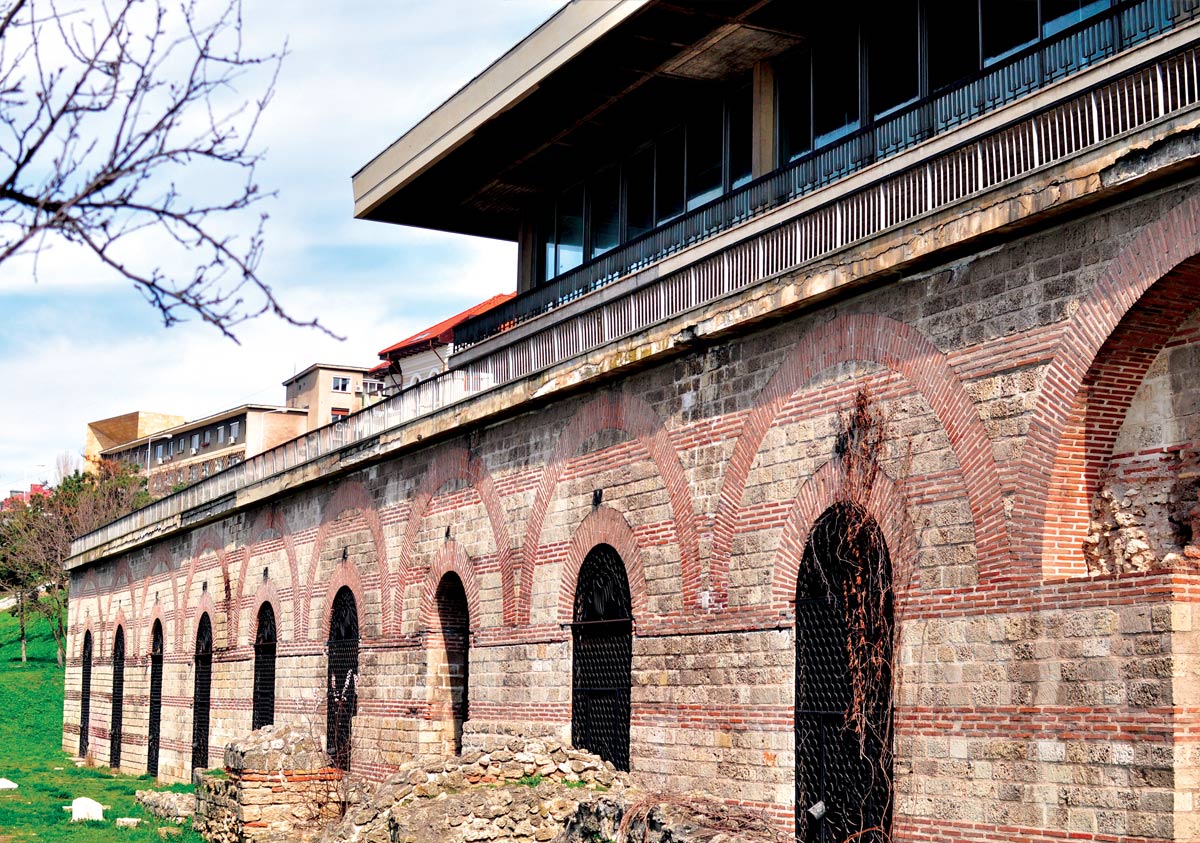


The galleries of the drinking water supply system could be identified in the basement of the ancient city and at the base of the cliffs, with entrances that can be observed at the Modern Beach, the Port of Tomis, School 2, the Courthouse, the Roman Mosaic Building and the Roman Baths Boulevard. Following the research carried out in the 1980s and 1990s by the late archaeologist Ghiorghe Papuc, the route of the aqueducts that brought water to Tomis could be reconstructed. The aforementioned specialist discovered a masonry aqueduct, of the type canalis structilis.
The network started from Canara in the area of the old Turkish fountain, reached Pescărie and then continued along the shore to the eastern part of the city of Tomis. Here, the aqueduct passed through galleries located at a depth of over 20 meters from the current level of the city, being dug into the limestone rock of the Tomis promontory. A section of the aqueduct started from the current area of the Tomis Tourist Port, passed under Ovidiu Square, under the current History Museum and under the Roman Mosaic Building and ended in front of it. The water was extracted through wells located near the thermal baths. Archaeologists have found built-in and plastered pools with hydraulic lime, pools that were very likely water storage tanks. The water was used for the daily use of the population, but also for the city's public baths, the entire system also having the purpose of protecting drinking water in the event of attacks or prolonged sieges.
The Tomis Baths, whose ruins can still be seen (partially) today near Gate 1, were monumental. Only part of the large thermal complex has been discovered (the rest has either been destroyed or is under modern buildings), namely a vast room of approximately 300 square meters, called Lentiarion. Its name was known thanks to an inscription discovered above one of the building's entrances. Lentiarionserved as a cloakroom, the place where those who came to the baths took their linen sheets. For the dating of the Baths, specialists have proposed the end of the 3rd century AD, probably during the time of Diocletian, or the beginning of the 4th century AD, during the time of Constantine the Great, when the Roman Edifice with Mosaic was also built.

Cecilia Artemisia
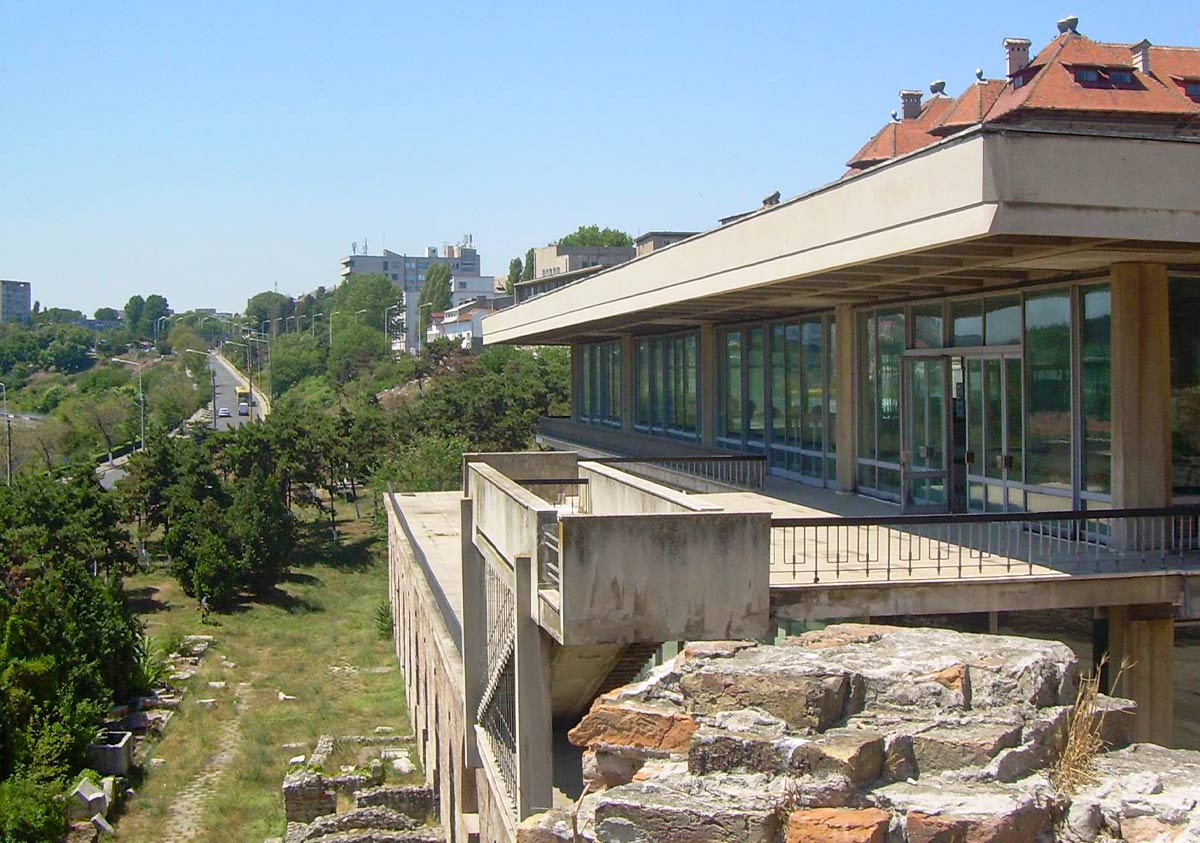
Another inscription in Greek on the alley leading to the Roman Mosaic Building tells us the true and tragic story of a young woman, Caecilia Artemisia, who lived in Tomis in the 2nd-3rd centuries AD. The text on the funerary altar reveals to us, from the very beginning, that this monument was erected in memory of the young woman by her grieving husband, Perinthos. We then learn some facts about the deceased:
"... And if you want to know, traveler, who and whose I am, listen: at 13 years old I fell in love with a young man, worthy of us, then I married him and gave birth to three children, a son first, then two daughters in my image."
The above words give us valuable information. That “worthy of us" is proof that Caecilia was part of a prominent Tomitian family (which also afforded an expensive funeral monument) and that her chosen one was no less. Also, the fact that the girl got married at only 13 years old should not be shocking if we take into account the realities of those times and the historical context. In a world haunted by epidemics and plagues, the average lifespan was very short, the hope of reaching old age – quite small, so girls got married very early, from 13-14 years old.
We then learn the dates of the tragedy, of the young woman's death: “… Finally, I gave birth for the fourth time, although I was not supposed to give birth. For the child died first, and after a short time, so did I. I left the sunlight at the age of 30…”
So, the young mother died shortly after a complicated birth, as a result of which the child did not survive either. Unfortunately, such cases were numerous in the era when the young woman from Tomis was such a victim.
Epifania
Many women of ancient Tomis have remained in the history of the place thanks to their charitable actions and the way they contributed to the life and development of the city. This is also the case of a woman from Tomis, Epifania, who lived in the 2nd-3rd centuries AD.
From her funerary inscription, written in Greek, we learn that she was born in Greece, to an Athenian mother and a father from Hermione, a city in the southern Greek province of Argolis. She had an adventurous life, at least for a time: Ihave seen many lands and sailed across the vast expanse of the sea, for my father and husband were my shipowners, whom, after death, I laid, with clean hands, in the grave. Truly happy was my life before.”According to epigraphists who studied the inscription, the premature death of the two men in Epiphania's life could have been caused by pirates who haunted the coasts of the Euxine and Mediterranean at that time.
After the tragedy, Epifania settled in Tomis and became involved in helping the poor: "...I was born among the Muses and shared in the goods of wisdom. As a woman, I gave much help to some women's deserted wives, being possessed by pious feelings. I also helped much to the one who was confined to the bed of suffering…”.

What is known is that in Tomis, Epifania rebuilt her life, marrying a man born in Ancyra (today Ankara, Turkey) and who survived her: “Hermogenes, the Ancyrian and Tomitan, from the tribe of Oinopes, full of gratitude to his wife consecrated this monument, as a memory.”
The Greek name Epiphany comes from the term epiphany which represents a revelation of a sacred reality or a mystical world.

Lilas
The funerary altars at Tomis often refer to fate and the fact that it cannot be known or changed by mortals. A beautiful funerary stele (probably from the 4th century AD) that makes such a reference is the one dedicated to the child Lilas, by his father Bassianus. It is an epigram in the form of a dialogue: three lines belong to the deceased child, three to the grieving parent, and the last is a greeting to passers-by. The text tells us the following:
"Memory. Nothing depends on people, everything revolves under the power of destiny. For I too have striven to raise a child and guide him towards the realization of his hopes. But the decision of destiny, through this grave, has taken precedence over my will."
As fate decrees, my dears, I paid my due fate before I reached the age of maturity and entered the ranks of men. When I was a child, small and young, my name was Lilas. For whom I, Bassianus, the father, together with my wife Januaria, the much-wept, mourned together the painless birth of the child.
Greetings, passerby, and health to the others again." (text source – ISM II, 384 (220)).
The Sarcophagus with symbols
The grave of the great Ovid has not yet been discovered… It is known that the Latin poet was buried with great pomp, near one of the gates of the city of Tomis, “ante oppidi portam", as the Italian medieval humanists of the 15th century wrote, citing ancient sources. Perhaps he was buried near the gate whose ruins are today found on Dragoș Vodă Street, in an era when Tomis of the 1st century AD did not exceed, according to specialists, the northern limit of Ovidius Square.

It is also unknown whether Ovid was buried or cremated, as both funeral rites coexisted in his time. Numerous versions have been circulated regarding the possible location of his tomb, but the mystery has not been solved.
What is certain is that this enigma of Naso's tomb has always aroused maximum interest, spirits have been inflamed, creating all kinds of stories, more or less true, but which have kept Ovid's memory alive.
One of the sarcophagi located in the lapidarium next to the Roman Mosaic Building is related to the city's desire to find out the secret of Ovid's death. It is the Sarcophagus with Symbols, an impressive monument, which can still be admired today. The artifact also has a very interesting story, because in the 30s it was believed to be the sarcophagus of the great Ovid, which triggered a great scandal of the time...
In the summer of 1931, at the end of Avram Iancu Street, at the intersection with the road leading to Vii and right next to the Municipal Hospital (today the Infectious Diseases Hospital), reinforcement and terracing works were carried out.
During these works, this huge marble sarcophagus was discovered, weighing about 8 and a half tons. Its discovery immediately attracted the attention of the public. The world was impressed by the monument of Greek marble, white-violet, 2 meters and 70 centimeters long, about 1.5 m wide and 2 meters and 40 cm high. The sarcophagus attracted attention from the first thanks to the symbols with which it was decorated.
In 1931, this monument was one of the largest ever discovered in Europe and its mysterious designs excited the public from the very beginning. There was no inscription that would clarify the identity of the one who had been laid in that tomb. It was a unique discovery especially thanks to the 7 mysterious symbols, beautifully worked in relief: On the right of the facade – a scale with 2 plates, a bull's head, tied on the forehead with a ribbon, an axe and a spear; On the left of the facade – three other symbols; a serpentine whip, a bell and below them, pliers. Another very interesting element is the representation on the side of the sarcophagus of Medusa, the legendary being whose gaze turned any mortal to stone and who was beheaded by the hero Perseus.
All the elements presented above served the enthusiasts who had been waiting for a long time for the discovery of Ovid's tomb. It is not known who was the first to circulate the hypothesis that the sarcophagus belonged to the exiled poet. What is certain is that the idea caught on from the first moment and was embraced with great enthusiasm by many people. The laymen said that the symbols were related to the professions and qualities that Ovid would have had, the balance being put in relation to his legal activity. In vain some tried to temper the majority: these skeptics were silenced or even taken to task if they had the nerve to assert that the sarcophagus did not belong to the great poet.


Romanian archaeologists began to carefully examine the monument, this being the only solution to end the general ecstasy. Western specialists also got on the bandwagon. The problem had become a continental one: the so-called news of the discovery of Ovid's tomb had attracted the attention of all of Europe and beyond... The Italians from Sulmona, the poet's hometown, were also very interested...
Gradually, it becomes clearer that the sarcophagus with symbols must be dated at least a century later than Ovid (2nd century). More recently, archaeologists have established that the deceased buried in this huge marble monument lived somewhere in the 3rd-4th centuries AD. The laborious research of specialists from Romania and other European countries clarified the issue of the sarcophagus's dating in less than a year. Unfortunately, enthusiasts and thrill seekers had to accept, in the end, that that monument had no connection with Ovid's final resting place.
Today, specialists tend to believe that the Sarcophagus with Symbols most likely belonged to an archigale, high priest of the goddess Cybele, the Great Mother of the Gods, a deity worshipped by many inhabitants of ancient Tomis.
The enigma of the tomb of Publius Ovidius Naso has not been solved to this day, but we can never know what the future will offer us...
The Sarcophagus of Alexandros
Right next to the Sarcophagus with Symbols, in the small park near the Constanța Museum of National History and Archaeology, there is another imposing monument, a marble coffin with an inscription in Greek. It is the so-called Sarcophagus of Alexandros of Tomita, discovered in 1959 on Cuza Vodă Street. It has been broken since ancient times, so today only the relief representing the deceased who gave it its name can be seen. The inscription on the long front side has been translated as follows: "Greetings, passerby! Alexandros, son of Zmaragdos, from the Oinopes tribe, benefactor, made the sarcophagus, for himself and for his wife Kyrilla, daughter of Philocles...".

The monument was dated to the Severan dynasty, somewhere around the end of the 2nd century – the beginning of the 3rd century AD, a period of development of the city, which came to acquire the nickname of “the most brilliant metropolis of the Left Pontus”. It is assumed that on the left side, opposite the relief of Alexandros, there was the bust of his wife Kyrilla. The monument also features the image of Medusa, symbol of metamorphosis and protector of tombs.
Without a doubt, Alexandros was a prominent man of the city, wealthy and involved in the life of the city ("benefactor"), and who was part of the Oinopes tribe, one of the Miletus tribes identified at Tomis. He allowed himself the luxury of ordering an impressive sarcophagus, made at great expense, from the best quality marble, brought from mother Greece.