

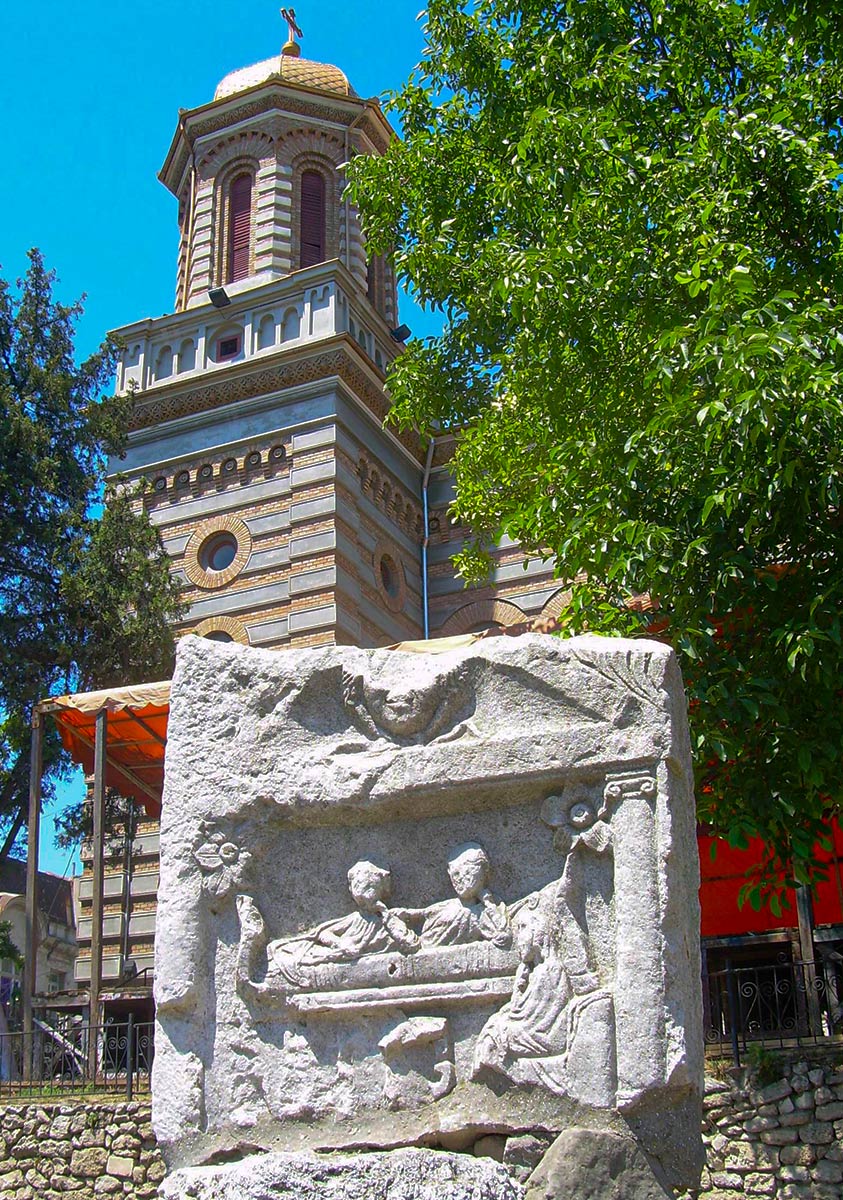
Cathedral Park
In the shadow of the great Orthodox Christian place of worship from which it takes its name, a few dozen meters away from the Casino cliff, lies the Cathedral Archaeological Park, one of the city's most interesting attractions.
Archaeological research here took place in the 1970s, carried out by a team from the Constanța Museum, and the extremely interesting results were published in the Pontica magazine by specialists Adrian Rădulescu and Constantin Scorpan. The special importance of the site lies, first of all, in the discovery of vestiges that can be linked to the founding of the settlement (in the first centuries – a emporion), by the Greeks of Miletus, in the 6th century BC. Thus, archaic Greek pottery was discovered, present through types and forms datable to the second half of the 6th century BC. or to the end of the 6th century BC. The fragments belong to amphorae from Chios or that came from other, undetermined centers, but also other types of vessels, cups, vats, etc. Luxury pottery was discovered, as well as pottery for everyday use, datable to the 6th-5th centuries BC. Many bronze arrowheads were also discovered, many of them with three edges (of the Scythian type) – pre-monetary signs that confirm the existence of a settlement in the 6th century BC, as well as the existence of trade exchanges between Greeks and natives.
The orthogonal organization of the urban fabric of the settlement seems to date from the Hellenistic period, which was to be preserved until the early Byzantine period (5th-6th century AD). The houses in this residential district are located at the intersection of two streets, oriented NW-SE and NE-SW, respectively. These are the axes of urban organization that Tomis will follow until the 6th century, at least in the old part of the city (up to today's Ovidiu Square).
Beyond the importance of the oldest evidence of habitation on the Tomitan peninsula from the Archaic period (6th century BC), the Cathedral Park offers visitors a residential district that shows continuity from the Hellenistic, then Roman and early Byzantine periods. Several layers and levels of habitation from the first centuries after Christ have been identified. However, it must be said that the level from the 5th-6th centuries AD (Roman-Byzantine era) was destroyed, almost completely razed, at the end of the 19th century, when the Cathedral of Saints Peter and Paul was built and at the beginning of the 20th century, when modern urban development continued in Constanța. Thus, what remained were mainly housing complexes and a street network, all datable starting with the 1st century and especially up to the 4th century AD, with some evidence remaining for the 5th and 6th centuries (foundations of stone walls bound with earth, a well). Several dwellings date from the 2nd-3rd centuries AD, but the 4th century is best represented. The NW/SE oriented street, with a total width of 5 m, which has been in use since the Hellenistic period, presents three phases of development, datable to the 4th-5th centuries AD.
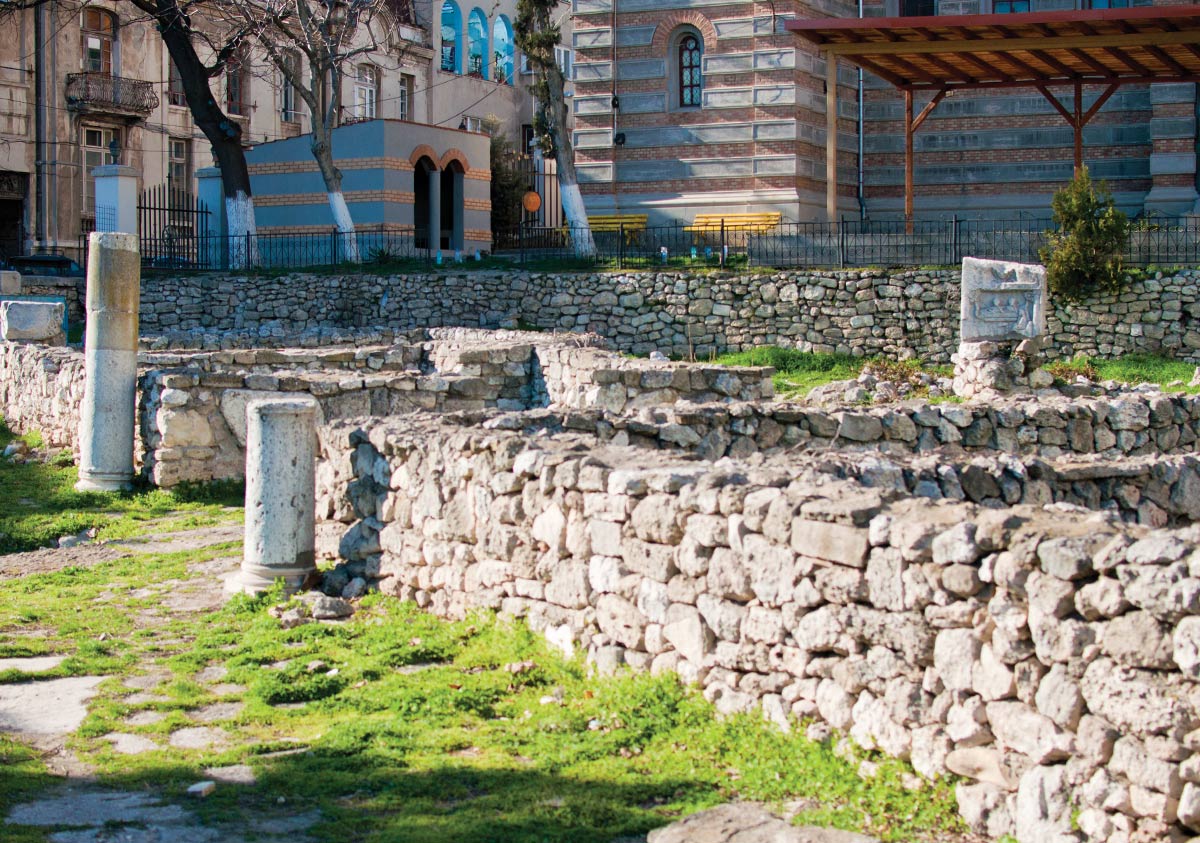
The most complex redevelopment is the last one, made in the 5th century AD, contemporary with the construction of the buildings with mortar-bound walls, which flank it on the E side. The second street, which follows the NE-SW direction, intersects at right angles with the first. It was cleared over a length of 24 m. It has an early Roman level (1st-2nd centuries AD) represented by a pavement of stone slabs well fixed in the yellow soil. In the 3rd-4th centuries AD the street was accompanied on the east side by a sidewalk, with two phases of operation, made up of large stone blocks.
A heated thermal building (Roman baths, public or private) dates from the 4th-5th centuries AD, traces of which have also been recorded in other surveys and rescue excavations carried out on Arhiepiscopiei Street.