Strada Arhiepiscopiei nr. 7, Piața Ovidiu, Constanța

Strada Arhiepiscopiei nr. 7, Piața Ovidiu, Constanța

Category: Exponatul lunii

EXPONATUL LUNII IUNIE 2025

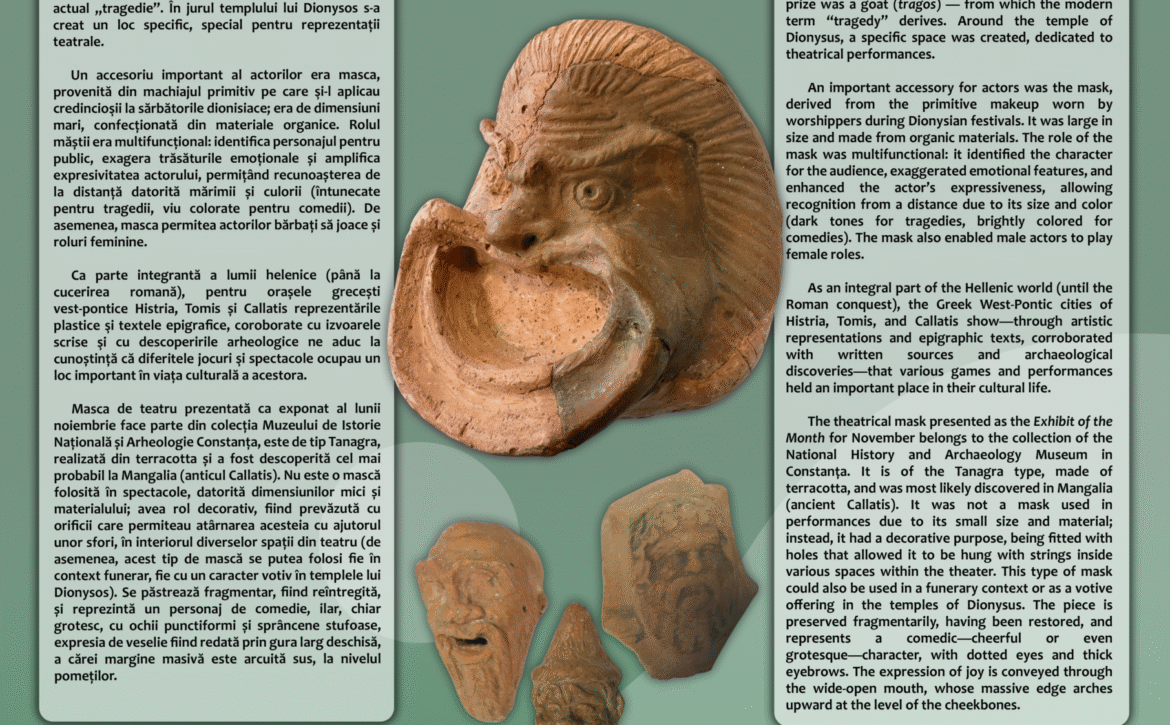
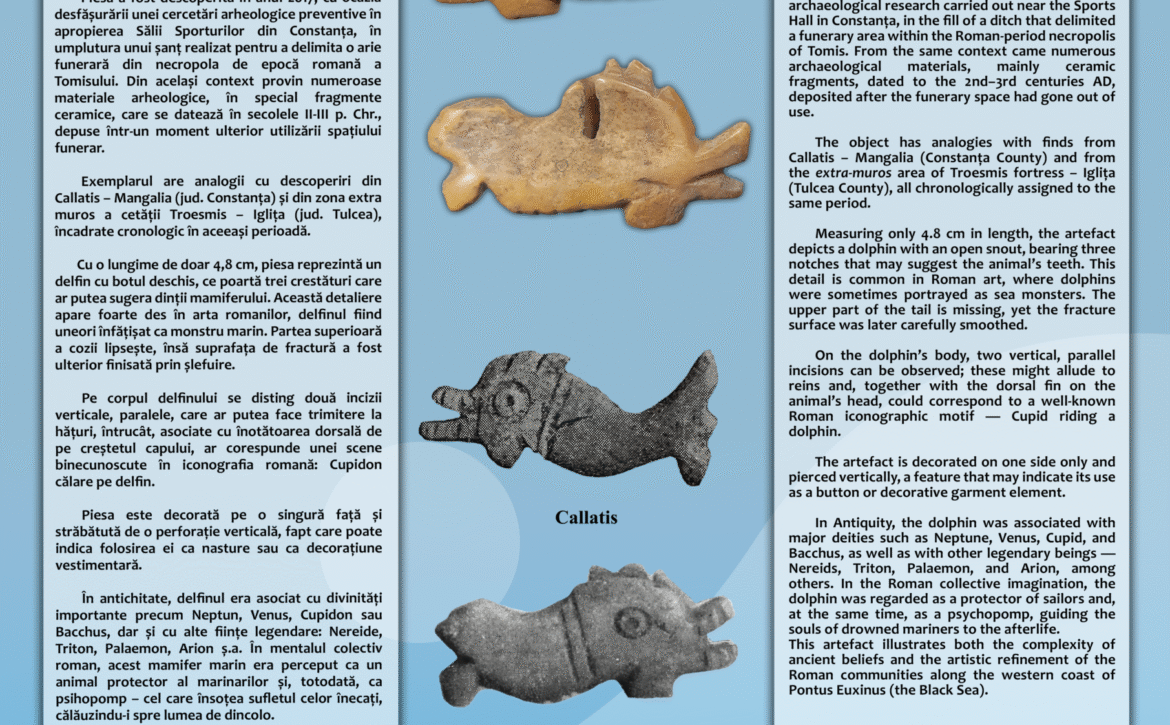
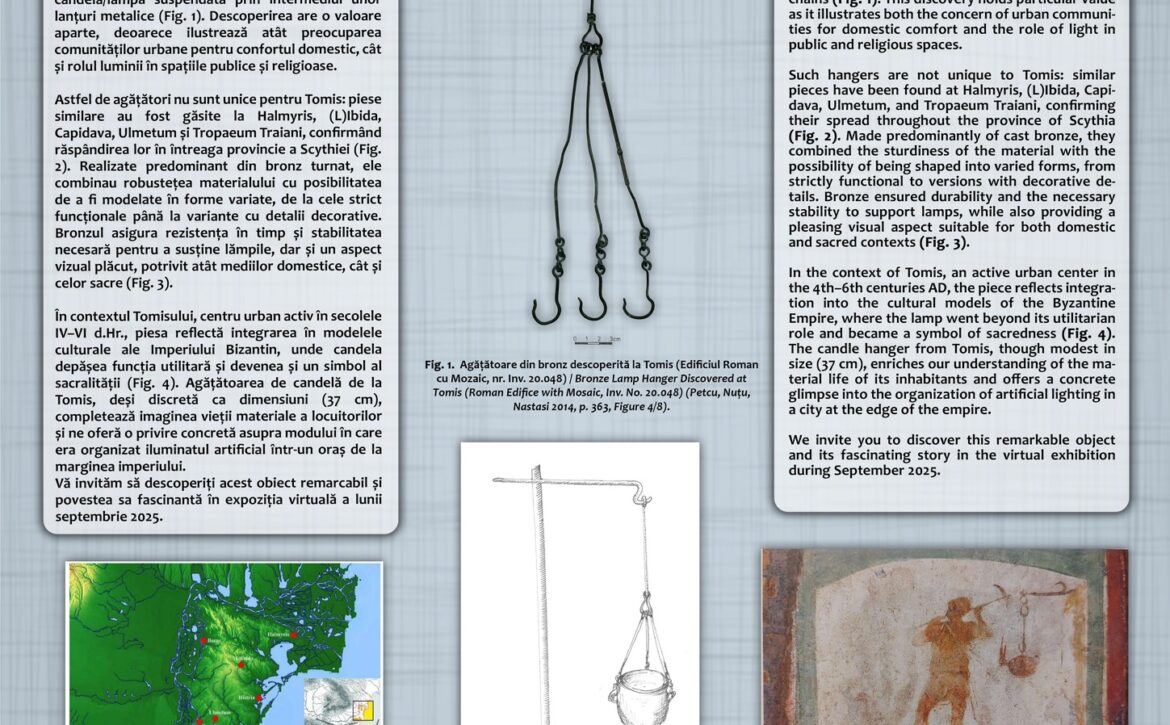
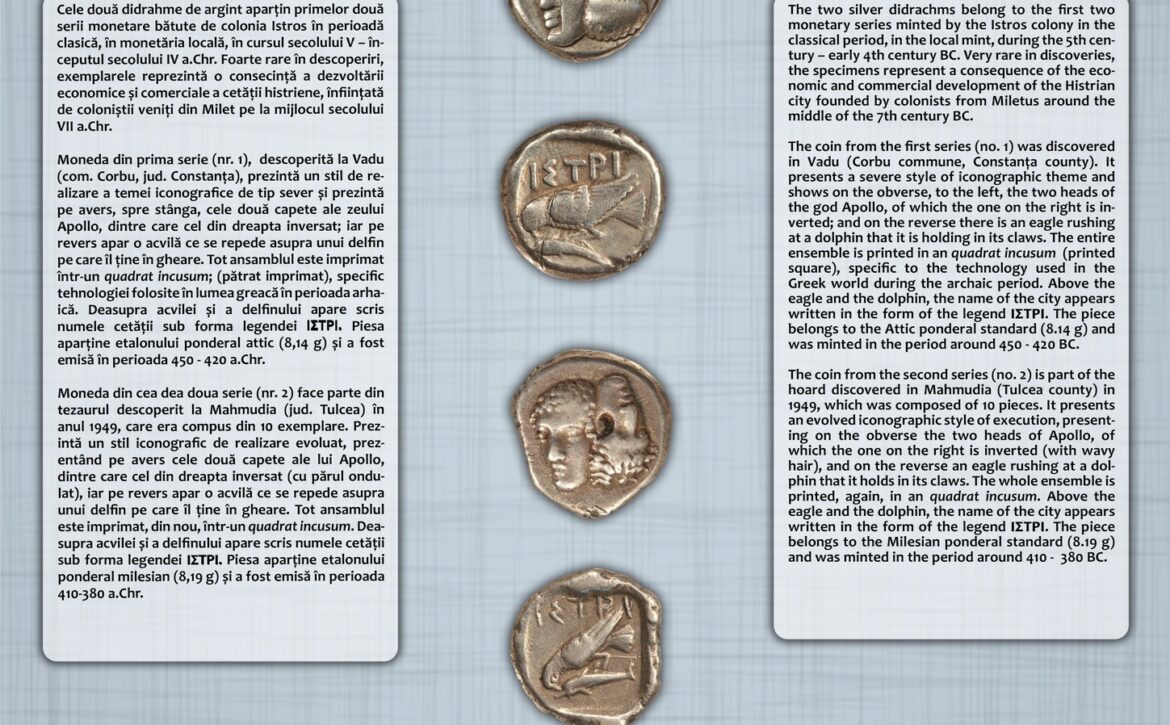
Exponatul lunii iunie 2025 – Grup statuar cu jocul „ephedrismos” sau „cal și călăreț”

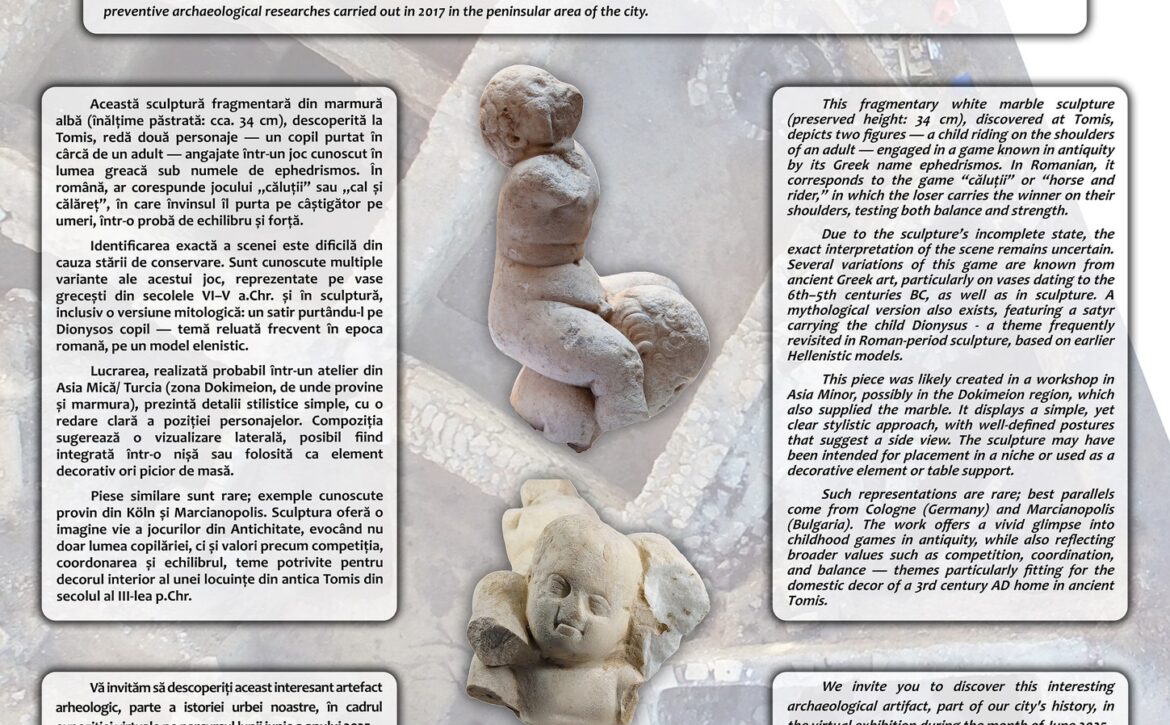
          Muzeul de Istorie Națională și Arheologie Constanța vă prezintă în luna iunie un grup statuar din marmură, descoperit la Tomis/Constanța, în cursul unor cercetări arheologice preventive desfășurate în anul 2017 în zona peninsulară a orașului.

Această sculptură fragmentară din marmură albă (înălțime: cca 34 cm), descoperită la Tomis, redă două personaje — un copil purtat în cârcă de un adult — angajate într-un joc cunoscut în lumea greacă sub numele de ephedrismos. În română, ar corespunde jocului „căluții” sau „cal și călăreț”, în care învinsul îl purta pe câștigător pe umeri, într-o probă de echilibru și forță.

Identificarea exactă a scenei este dificilă din cauza stării de conservare. Sunt cunoscute multiple variante ale acestui joc, reprezentate pe vase grecești din secolele VI–V a.Chr. și în sculptură, inclusiv o versiune mitologică: un satir purtându-l pe Dionysos copil — temă reluată frecvent în epoca romană, pe un model elenistic.

Lucrarea, realizată probabil într-un atelier din Asia Mică (zona Dokimeion, de unde provine și marmura), prezintă detalii stilistice simple, cu o redare clară a poziției personajelor. Compoziția sugerează o vizualizare laterală, posibil fiind integrată într-o nișă sau folosită ca element decorativ ori picior de masă.

Piese similare sunt rare; exemple cunoscute provin din Köln și Marcianopolis. Sculptura oferă o imagine vie a jocurilor din Antichitate, evocând nu doar lumea copilăriei, ci și valori precum competiția, coordonarea și echilibrul, teme potrivite pentru decorul interior al unei locuințe din antica Tomis din secolul al III-lea p.Chr.

Vă invităm să descoperiți aceast interesant artefact arheologic, parte a istoriei urbei noastre, în cadrul expoziției virtuale pe parcursul lunii iunie a anului 2025.

Statuary Group Depicting the Game Ephedrismos, or “Horse and Rider” / Piggyback

In June, the Museum of National History and Archaeology of Constanța presents a marble statuary group discovered in Tomis/Constanța, during preventive archaeological researches carried out in 2017 in the peninsular area of the city.

This fragmentary white marble sculpture (height: approx. 34 cm), discovered at Tomis, depicts two figures — a child riding on the shoulders of an adult — engaged in a game known in antiquity by its Greek name ephedrismos. In Romanian, it corresponds to the game “căluții” or “horse and rider,” in which the loser carries the winner on their shoulders, testing both balance and strength.

Due to the sculpture’s incomplete state, the exact interpretation of the scene remains uncertain. Several variations of this game are known from ancient Greek art, particularly on vases dating to the 6th–5th centuries BC, as well as in sculpture. A mythological version also exists, featuring a satyr carrying the child Dionysus – a theme frequently revisited in Roman-period sculpture, based on earlier Hellenistic models.

This piece was likely created in a workshop in Asia Minor, possibly in the Dokimeion region, which also supplied the marble. It displays a simple, yet clear stylistic approach, with well-defined postures that suggest a side view. The sculpture may have been intended for placement in a niche or used as a decorative element or table support.

Such representations are rare; best parallels come from Cologne (Germany) and Marcianopolis (Bulgaria). The work offers a vivid glimpse into childhood games in antiquity, while also reflecting broader values such as competition, coordination, and balance — themes particularly fitting for the domestic decor of a 3rd century AD home in ancient Tomis.

We invite you to discover this interesting archaeological artifact, part of our city’s history, in the virtual exhibition during the month of June 2025.

Curatori:

dr. Cristina Georgeta Alexandrescu, cercetător științific II (Institutul de Arheologie „Vasile Pârvan” din București

dr. Aurel Mototolea, muzeograf (Muzeul de Istorie Națională și Arheologie Constanța)

Bibliografie / Bibliography

C.-G. Alexandrescu, A. Mototolea, T. Potârniche, Sculptural and architectural finds recently discovered in the rescue archaeological excavations carried out at Tomis in the 2016 – 2019 campaigns, forthcoming.

F. Brommer, Huckepack, The J. Paul Getty Museum Journal, 6-7, 1978-1979, 139-146.

R. Schmidt, Die Darstellung von Kinderspielzeug und Kinderspiel in der griechischen Kunst, Viena, 1977.

Read More
EXPONATUL LUNII MAI 2025

Exponatul lunii mai 2025 – O statuetă din fildeș cu reprezentarea zeului Thanatos descoperită la Palazu Mare

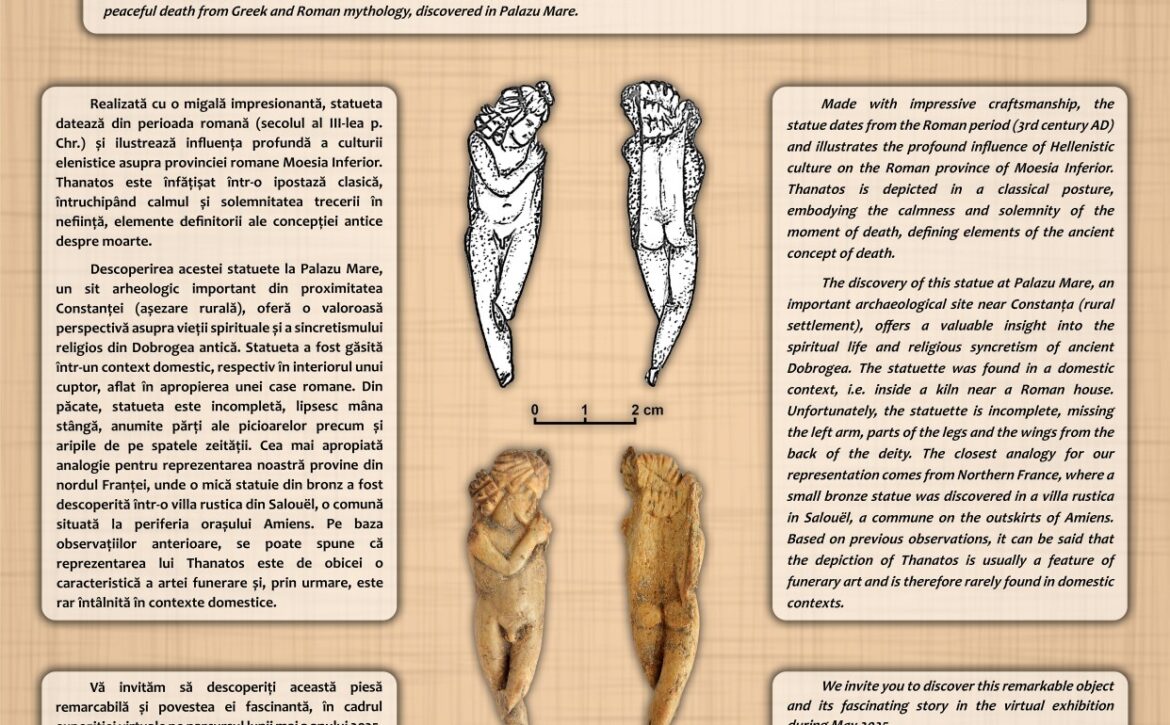
          Muzeul de Istorie Națională și Arheologie Constanța vă prezintă în luna mai o piesă deosebită: o statuetă din fildeș, descoperită la Palazu Mare și care îl înfățișează pe Thanatos, zeul morții liniștite din mitologia greacă și romană.

Realizată cu o migală impresionantă, statueta datează din perioada romană (secolul al III-lea p. Chr.) și ilustrează influența profundă a culturii elenistice asupra provinciei romane Moesia Inferior. Thanatos este înfățișat într-o ipostază clasică, întruchipând calmul și solemnitatea trecerii în neființă, elemente definitorii ale concepției antice despre moarte.

Descoperirea acestei statuete la Palazu Mare, un sit arheologic important din proximitatea Constanței (așezare rurală), oferă o valoroasă perspectivă asupra vieții spirituale și a sincretismului religios din Dobrogea antică. Statueta a fost găsită într-un context domestic, respectiv în interiorul unui cuptor, aflat în apropierea unei case romane. Din păcate, statueta este incompletă, lipsesc mâna stângă, anumite părți ale picioarelor precum și aripile de pe spatele zeității. Cea mai apropiată analogie pentru reprezentarea noastră provine din nordul Franței, unde o mică statuie din bronz a fost descoperită într-o villa rustica din Salouël, o comună situată la periferia orașului Amiens. Pe baza observațiilor anterioare, se poate spune că reprezentarea lui Thanatos este de obicei o caracteristică a artei funerare și, prin urmare, este rar întâlnită în contexte domestice.

Vă invităm să descoperiți această piesă remarcabilă și povestea ei fascinantă, în cadrul expoziției virtuale pe parcursul lunii mai a anului 2025.

An ivory statuette of the god Thanatos discovered in Palazu Mare

In May, the Museum of National History and Archaeology of Constanta presents a special object: an ivory statuette depicting Thanatos, the god of the peaceful death from Greek and Roman mythology, discovered in Palazu Mare.

Made with impressive craftsmanship, the statue dates from the Roman period (3rd century AD) and illustrates the profound influence of Hellenistic culture on the Roman province of Moesia Inferior. Thanatos is depicted in a classical posture, embodying the calmness and solemnity of the moment of death, defining elements of the ancient concept of death.

The discovery of this statue at Palazu Mare, an important archaeological site near Constanța (rural settlement), offers a valuable insight into the spiritual life and religious syncretism of ancient Dobrogea. The statuette was found in a domestic context, i.e. inside a kiln near a Roman house. Unfortunately, the statuette is incomplete, missing the left arm, parts of the legs and the wings from the back of the deity. The closest analogy for our representation comes from Northern France, where a small bronze statue was discovered in a villa rustica in Salouël, a commune on the outskirts of Amiens. Based on previous observations, it can be said that the depiction of Thanatos is usually a feature of funerary art and is therefore rarely found in domestic contexts.

We invite you to discover this remarkable object and its fascinating story in the virtual exhibition during May 2025.

Bibliografie:

Covacef, Z., Thanatos – simbol al nemuririi în arta funerară din Scythia Minor, Peuce 6, 1977, pp. 191–197.

Petcu-Levei I., Petcu R., An ivory statuette depicting the god Thanatos discovered near Tomis (Moesia Inferior), Dissertationes Archaeologicae 3.12, 2024, pp. 333–342.

Curatori:

Ingrid Petcu-Levei, Arheolog

Radu Petcu, Cercetător științific

Read More
EXPONATUL LUNII APRILIE 2025

Exponatul lunii aprilie 2025 – Placă de marmură, dedicată unui martir al lui Hristos, descoperită la Tomis

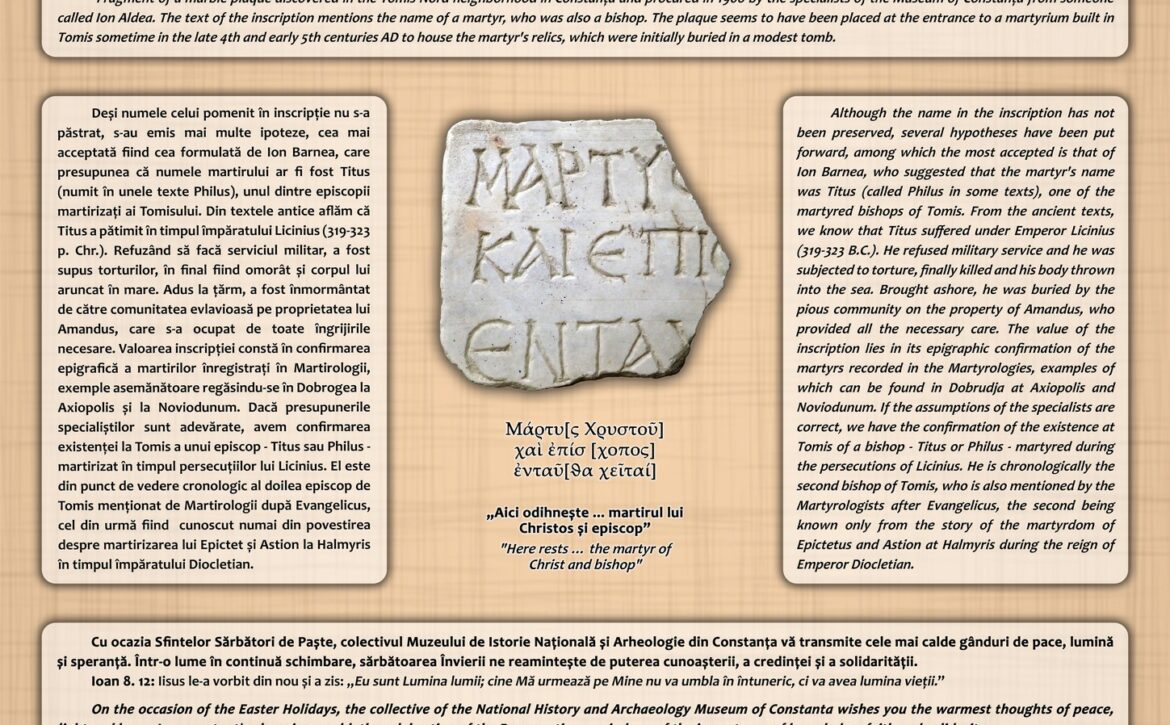
Fragment dintr-o placă de marmură descoperită în cartierul Tomis Nord și achiziționată în anul 1968 de către specialiștii Muzeului din Constanța de la un anume Ion Aldea. Textul inscripției pomenește numele unui martir, care a fost și episcop. Placa pare să fi fost așezată la intrarea unui martyrium, construit la Tomis undeva la sfârșitul secolului al IV-lea p. Chr. și începutul secolului următor, pentru adăpostirea moaștelor, depuse inițial într-un mormânt mai modest.

Μάρτυ[ς Χρυστοῦ]

χαὶ ἐπίσ [χοπος]

ἐνταῦ[ϑα χεῖταί]

„Aici odihnește … martirul lui Christos și episcop”

Deși numele celui pomenit în inscripție nu s-a păstrat, s-au emis mai multe ipoteze, cea mai acceptată fiind cea formulată de Ion Barnea, care presupunea că numele martirului ar fi fost Titus (numit în unele texte Philus), unul dintre episcopii martirizați ai Tomisului. Din textele antice aflăm că Titus a pătimit în timpul împăratului Licinius (319-323 p. Chr.). Refuzând să facă serviciul militar, a fost supus torturilor, în final fiind omorât și corpul lui aruncat în mare. Adus la țărm, a fost înmormântat de către comunitatea evlavioasă pe proprietatea lui Amandus, care s-a ocupat de toate îngrijirile necesare. Valoarea inscripției constă în confirmarea epigrafică a martirilor înregistrați în Martirologii, exemple asemănătoare regăsindu-se în Dobrogea la Axiopolis și la Noviodunum. Dacă presupunerile specialiștilor sunt adevărate, avem confirmarea existenței la Tomis a unui episcop – Titus sau Philus – martirizat în timpul persecuțiilor lui Licinius. El este din punct de vedere cronologic al doilea episcop de Tomis menționat de Martirologii după Evangelicus, cel din urmă fiind  cunoscut numai din povestirea despre martirizarea lui Epictet și Astion la Halmyris în timpul împăratului Diocletian.

Cu ocazia Sfintelor Sărbători de Paște, colectivul Muzeului de Istorie Națională și Arheologie din Constanța vă transmite cele mai calde gânduri de pace, lumină și speranță. Într-o lume în continuă schimbare, sărbătoarea Învierii ne reamintește de puterea cunoașterii, a credinței și a solidarității. 

Ioan 8. 12: Iisus le-a vorbit din nou și a zis: „Eu sunt Lumina lumii; cine Mă urmează pe Mine nu va umbla în întuneric, ci va avea lumina vieții.”

Christian testimonies from ancient Dobrogea (III) –

Marble plaque dedicated to a martyr of Christ discovered in Tomis

Fragment of a marble plaque discovered in the Tomis Nord neighborhood in Constanța and procured in 1968 by the specialists of the Museum of Constanța from someone called Ion Aldea. The text of the inscription mentions the name of a martyr, who was also a bishop. The plaque seems to have been placed at the entrance to a martyrium built in Tomis sometime in the late 4th and early 5th centuries AD to house the martyr’s relics, which were initially buried in a modest tomb.

Μάρτυ[ς Χρυστοῦ]

χαὶ ἐπίσ [χοπος]

ἐνταῦ[ϑα χεῖταί]

“Here rests … the martyr of Christ and bishop”

Although the name in the inscription has not been preserved, several hypotheses have been put forward, among which the most accepted is that of Ion Barnea, who suggested that the martyr’s name was Titus (called Philus in some texts), one of the martyred bishops of Tomis. From the ancient texts, we know that Titus suffered under Emperor Licinius (319-323 B.C.). He refused military service and he was subjected to torture, finally killed and his body thrown into the sea. Brought ashore, he was buried by the pious community on the property of Amandus, who provided all the necessary care. The value of the inscription lies in its epigraphic confirmation of the martyrs recorded in the Martyrologies, examples of which can be found in Dobrudja at Axiopolis and Noviodunum. If the assumptions of the specialists are correct, we have the confirmation of the existence at Tomis of a bishop – Titus or Philus – martyred during the persecutions of Licinius. He is chronologically the second bishop of Tomis, who is also mentioned by the Martyrologists after Evangelicus, the second being known only from the story of the martyrdom of Epictetus and Astion at Halmyris during the reign of Emperor Diocletian.

On the occasion of the Easter Holidays, the collective of the National History and Archaeology Museum of Constanta wishes you the warmest thoughts of peace, light and hope. In a constantly changing world, the celebration of the Resurrection reminds us of the importance of knowledge, faith and solidarity. 

John 8. 12: When Jesus spoke again to the people, he said: “I am the light of the world. Whoever follows me will never walk in darkness, but will have the light of life.”

Bibliografie:

Barnea, I., Inscripții Paleocreștine inedite din Tomis, Pontica 7, 1974, pp. 377-385.

Barnea, I., Christian Art in Romania, vol. 1: 3rd-6th Centuries, București 1979, pp. 44-45, pl. 4/2.

Fontes Historiae Daco-Romane, II, București, p. 704-707.

IGLR 22 – Inscripţiile greceşti şi latine din secolele IV–XIII descoperite în România, E. Popescu (ed.), București, 1976.

Curator:

Radu Petcu, Cercetător științific

Read More
EXPONATUL LUNII MARTIE 2025

Exponatul lunii martie 2025 – Stăpână a magiei și a înțelepciunii, Isis la Tomis

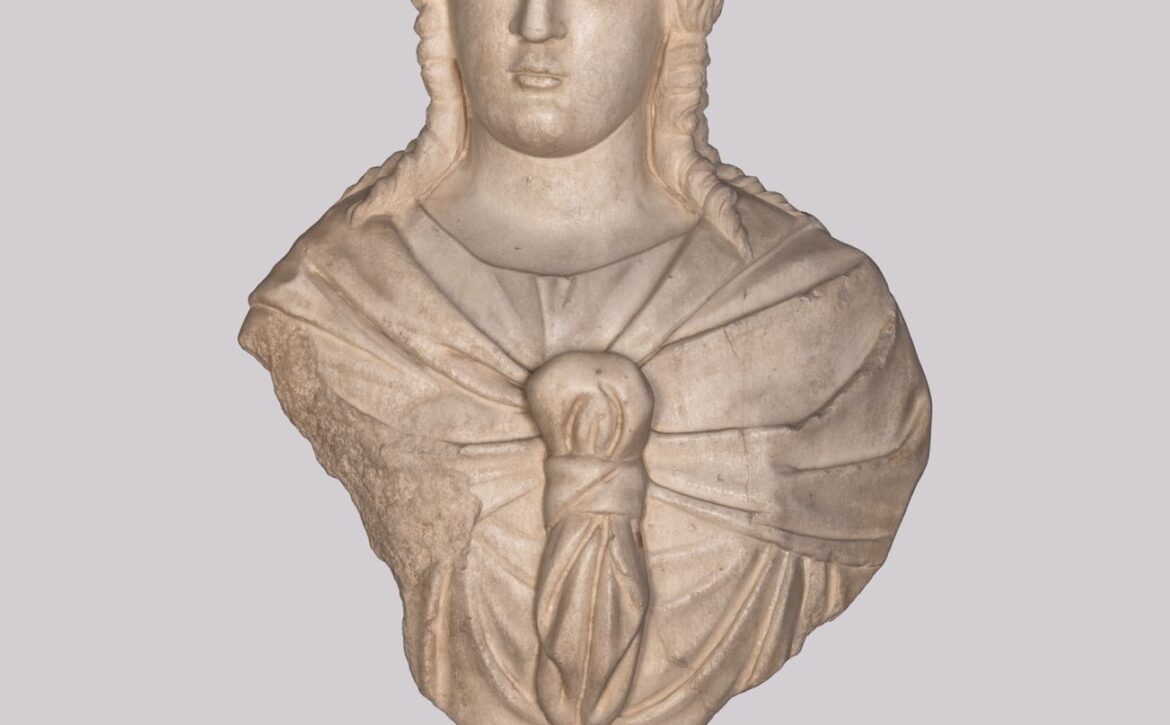
În această lună dedicată prin excelență femeilor, Muzeul de Istorie Națională și Arheologie Constanța vă prezintă o piesă sculpturală de exepție ce o reprezintă pe Isis, zeița  maternității, fertilității, a magiei, a vindecării și a renașterii.

În primăvara anului 1962, în timpul unor lucrări edilitare, a apărut capul unei statui de marmură. Arheologii, chemați de urgență în zonă, aveau să constate că era vorba despre descoperirea spectaculoasă a 24 de sculpturi, cunoscută în literatura de specialitate sub numele de Tezaurul de sculpturi de la Tomis.

Pintre acestea se afla și un bust al zeiței Isis, lucrat în marmură de culoare albă, lucrarea de o mare valoare artistică și științifică, ce reprezintă unul dintre cele mai prețioase artefacte din colecția muzeului  constănțean.

Piesa conține elementele de identificare ale divinității, aceasta fiind una dintre puținele reprezentări ale lui Isis care păstrează integral detaliile feței. Zeița este înfățișată cu părul foarte bogat, pieptănat într-o manieră specifică, cu o cărare care se prelungește în spate până aproape de ceafă. Detaliile feței sunt redate realist, de aici și propunerea specialiștilor cu privire la faptul că artistul a folosit un model viu. Figura este senină, ochii sunt mari și expresivi, iar arcadele sprâncenelor, frumos alungite și arcuite. Gura este mică, cu buzele strânse într-un surâs greu perceptibil. La gât este vizibil chiton-ul acoperit de un himation, ale cărui colțuri sunt legate într-un nod cunoscut sub numele de „nodul isiac”.

Cu rădăcini bine-cunoscute în religia egipteană, soție devotată a lui Osiris și mama lui Horus, Isis a fost subiectul unei reinterpretări în epocă elenistică și romană, fapt ce a permis cultului ei să depășească granițele pământului natal, ajungând și pe țărmul Mării Negre, la Tomis. Epitete precum Fortuna, Augusta, Invicta, Victrix, Basileia, demonstrează faptul că zeița protectoare era adorată de toate păturile societății, de la sclavi, femei și copii, până la comercianți, militari, magistrați, fiind chiar una dintre divinitățile protectoare ale casei imperiale. Ea patrona dragostea erotică și dragostea conjugală, magia, înțelepciunea, sănătatea, norocul și victoria asupra vicisitudinilor vieții, fiind unul dintre modelele feminine cele mai de succes pe parcursul Antichității. Sub forma de Isis lactans, aceasta era protectoarea femeilor însărcinate și a copiilor, imaginea ei cu pruncul așezat pe genunchi fiind unul dintre modelele preluate de către creștinism.

Zeiței Isis îi era dedicat unul dintre cele mai importante festivaluri religioase antice,  Navigium Isidis sau Isidis Navigium, celebrat anual la 5 martie. În prezent se consideră că o bună parte din imaginea colectivă a festivalului modern cu care alegorice are ca rădăcină această sărbătoare antică. Isis avea și calitatea de „Sfântă Fecioară a Mării” (Πελαγία), fiind celebrată și la Inventio Osiridis, ale cărui solemnităţi din toamnă aveau loc la închiderea sezonului navigabil și durau din 28 octombrie până în 3 noiembrie.

Datorită dedicațiilor epigrafice, știm că încă din perioadă elenistică, Isis a fost venerată la Tomis împreună cu Sarapis, cultul ei perpetuându-se și în epocă romană. Isis nu a părăsit niciodată Tomisul, deși templul ei este demult distrus. Zeița încă veghează orașul de la înălțimea celebrității pe care o are, odată cu descoperirea sa în 1962, însă astăzi, în locul unui templu, o găsim în sala-tezaur a instituție noastre. Colectivul Muzeului de Istorie Națională și Arheologie Constanța aduce astfel un omagiu tuturor doamnelor și domnișoarelor! Lumea nu ar fi la fel fără magia și înțelepciunea pe care ele o aduc în viețile noastre și de aceea le urăm un sincer La mulți ani!

The mistress of magic and wisdom, Isis at Tomis

In the spring of 1962, during the excavation made for the foundations of a new block, whose location had been moved with about 30 m to protect the ruins of the great basilica of the ancient city, the head of a marble statue appeared. The archaeologists urgently called to the area, were to find that it was not a single discovery, but, after the archaeological research, a large pit was documented, and in which 24 sculptures were placed. This discovery is referred by the specialized literature as the treasure of sculptures from Tomis. Among these, was a bust made of white marble of the goddess Isis (MINAC no. inv. 2002). This work is of great artistic and scientific value, being one of the most precious artifacts housed in the collection of the Constanța museum.

The piece (h = 77.5 cm., d base = 20 cm., dated to the first half of the 3rd century AD) contains the identification elements of the divinity, therefore, being one of the few representations of Isis that fully preserves the details of the face. The goddess is depicted with very rich hair, combed in a specific manner, with a part that extends in the back almost to the beginning of the neck. On the top of the has lies one of the symbols specific to the goddess, the crescent moon (the detail is damaged). A rectangular hole about 4 cm deep was carved on the crown of the head, probably made in order to fix a mobile element in it, probably the representation of another symbol of the goddess. The details of the face are rendered realistically, hence the proposal of specialists regarding the fact that the sculptor used a live model. The figure is serene, the eyes are large and expressive, and the arches of the eyebrows are beautifully elongated. The mouth is small, with the lips pursed in a barely perceptible smile. At the neck is visible the chiton covered by a himation whose corners are tied together in a knot known as the “the knot of Isis”.

With well-known roots in Egyptian religion, the devoted wife of Osiris and mother of Horus, Isis is the subject of a reinterpretation in the Hellenistic and Roman periods, which will allow her cult to exceed the borders of her native land, reaching the shores of the Black Sea, at Tomis.

Epithets such as Fortuna, Augusta, Invicta, Myriopnyma, Victrix, Basileia, demonstrate that the goddess protects all levels of society, from slaves, women and young children, to merchants, soldiers, magistrates, being even one of the protective divinities of the imperial house. She reign over the erotic love and conjugal love, magic, wisdom, health, luck and victory over the vicissitudes of life, being one of the most successful female models throughout all the Antiquity.

In the form of Isis lactans, she is the protector of pregnant women and children, her image with the baby sitting on her lap, being one of the models taken over by Christianity.

One of the most important ancient religious festivals is the Navigium Isidis or Isidis Navigium, celebrated on 5 March and dedicated to the goddess at the beginning of the navigational season. It is now believed that much of the collective image for the modern festivals with their allegorical chariots, has roots in this ancient celebration. Isis also had the status of “Holy Virgin of the Sea” (Πελαγία), being celebrated also at the Inventio Osiridis, whose autumn solemnities, taking place at the close of the navigational season, and lasted several days (from 28 October to 3 November). At Tomis, she was often worshipped together with other divinities of Egyptian origin such as Sarapis, Anubis and Harpocrates, and was periodically celebrated in great public ceremonies known as the Feasts of Isis – charmosyna (χαρμοσυνα).

Due to the epigraphical dedications, we know that since the Hellenistic period, Isis was worshipped together with Sarapis at Tomis. In the Roman era, starting with the first century of the Empire, there is evidence that Tomis hosted many devotees of the cult of the Egyptian gods, organized in cult associations, some of them with an oriental origin, and led by priests who officiated the necessary ceremonies. The prosperity of the city is also reflected in the fact that Isis and her cult are attested at Tomis during the 1st-4th centuries AD. We do not know exactly what happened towards the end of this period, the twilight of the ancient gods of Tomis was a slower and less noisy one than in other places, as new research attests.

However, Isis never left Tomis, although her temple has long been destroyed. The goddess still watches over the city from the height of her fame with her discovery in 1962, but today, instead of a temple, you can find her in the treasure hall of the Constanța Museum of National History and Archaeology.

This month is dedicated par excellence to women, therefore, the team of the Museum of National History and Archaeology from Constanța pays a tribute to all the ladies and young ladies! The world would not be the same without the magic and wisdom they bring to our lives! Happy Birthday to all of them!

Read More
EXPONATUL LUNII FEBRUARIE 2025

Exponatul lunii februarie 2025 – Un inel de aur cu gemă gravată, descoperit recent în necropola Tomis-ului

În toamna anului 2023, cu ocazia unei cercetări arheologice efectuate în zonă gării din Constanța, a fost descoperit un mormânt de inhumație cu firidă laterală, orientat NE-SV. În interiorul firidei se aflau rămășițele, precar conservate, ale unui adult. Din inventarul funerar cu care acesta a fost așezat în mormânt, fac parte un opaiț, alături de două vase de sticlă și un vas din ceramică (așezate în zona capului), un inel din aur cu gemă (aflat pe mâna stângă) și un unguentarium din sticlă (așezat pe bazin). Datarea mormântului, a fost stabilită de către specialiști, în perioada secolului al II-lea p. Chr.

Dintre elementele deosebite prezente în acest mormânt, remarcăm inelul aflat pe unul dintre degetele mâinii stângi a defunctului. Acesta a fost lucrat din foaie de aur, având un diametru interior maxim de 1,6 cm. și are încastrată o intalie din carneol (0,9×0,6 cm), gravată cu imaginea Fortunei. Zeița este reprezentată cu veșmântul și coafura specifică, în mers spre dreapta și ținând în mâini atributele bine cunoscute. Astfel, cu mâna dreaptă, ea ține cornul abundenței sau cornucopia , iar cu cea stângă sprijină cârma unei corăbii sau gubernaculum, alături de spice de grâu și fructul de mac.

În lumea antică, zeița romană Fortuna și echivalentul ei grecesc Tyche, patronau norocul și soarta omenirii, căreia îi alegeau soarta ajutându-se de rota Fortunae/roata norocului și pe care o guvernau folosind gubernaculum. Ea reprezintă cel mai bun exemplu pentru a ilustra capriciul zeilor, care nu sunt drepți și judecă după dorința proprie, împărțind arbitrar, norocul și necazul pentru muritorii de rând.

La fel ca noi, și oamenii care au trăit în Tomis cu două mii de ani în urmă, se temeau de ceea ce le va aduce viitorul și încercau să înduplece soarta prin rugăciuni și portul unor obiecte cu imaginea zeilor capricioși, în speranța că îi vor îndupleca pe aceștia să le fie favorabili.

Tuturor, vă dorim ca Fortuna să vă protejeze viitorul!

Noroc bun și nu uitați, audentes Fortuna iuvat!

A gold ring with an engraved gem, recently discovered in the Tomis necropolis. The goddess Fortuna and the good luck of the mortals

In the fall of 2023, during an archaeological research carried out in the area of the railway station from Constanța, an inhumation grave with a lateral niche, oriented NE-SW, was discovered. Inside the niche were the poorly preserved remains of an adult. The funerary inventory with which he was placed in the tomb includes a lamp, along with two glass vessels and a ceramic vessel (placed in the head area), a gold ring with a gem (on the left hand) and a glass unguentarium (placed on the basin). The dating of the tomb was established by specialists, in the 2nd century AD.

Among the special elements present in this tomb, we note the ring found on one of the fingers of the deceased’s left hand. It was made of gold leaf, with a maximum internal diameter of 1.6 cm., and has a carnelian gem (0.9×0.6 cm) engraved with the image of the goddess Fortuna. She is represented with her specific garment and hairstyle, walking to the right and holding the well-known attributes in her hands. Thus, with her right hand she holds the horn of abundance or cornucopia, and with her left she supports the rudder of a ship or gubernaculum, along with ears of wheat and a poppy fruit.

In the ancient world, the Roman goddess Fortuna and her Greek equivalent Tyche, were the patron of the good luck and the future of humanity, for which they chose a fate using the rota Fortunae/wheel of fortune and which they governed using the gubernaculum. She represents the whim of the gods, who are not fair and judge according to their own wishes, distributing according to their will, luck and misfortune for ordinary mortals.

Therefore, just like us today, the people who lived in Tomis two thousand years ago, feared of what the future would bring and tried to appease fate through prayers and by wearing objects with the image of capricious gods, in the hope that they would persuade them to be favorable to them.

To all of you, we wish that Fortuna protects your future!

Good luck and don’t forget, audentes Fortuna iuvat!

Read More
EXPONATUL LUNII IANUARIE 2025

Exponatul lunii ianuarie 2025 -Capitel de marmură descoperit la Tomis cu monograma Episcopului Ioan (?)

Mărturii creștine din Dobrogea antică (II)

Fragment dintr-un capitel de marmură descoperit la Constanța în condiții necunoscute. Acesta poartă pe fața principală o monogramă cruciformă flancată de două caneluri largi, iar în colțuri este decorată cu câte o floare de crin. Monograma este înscrisă într-un cerc dublu și a fost citită Ἰωάννου. Se presupune că ar fi vorba despre Episcopul de Tomis, Ioan, care ar fi trăit aici în prima jumătate a sec. al V-lea p. Chr. Episcopul este menționat în scrierile antice ca fiind unul dintre apărătorii ortodoxiei în timpul marilor controverse nestoriene și monofizite din secolul al V-lea.

{monogramma:} Ἰωάννου (Ioannes)

Ioannes este un nume creștin de origine semitică și este frecvent întâlnit în inscripțiile din Scythia în sec. IV-VI p. Chr. Capitelul cu simboluri creștine se presupune că ar proveni de la un edificiu ecleziastic, poate chiar de la o biserică închinată Sfântului Ioan, la Tomis fiind identificate, până în prezent, opt lăcașuri de cult creștine. Ipoteza funcționării la Tomis a unei biserici dedicate Sfântului Ioan este confirmată de o stelă funerară datată în sec. IV-V p. Chr., ridicată pentru Maru, fiica lui Ioan (Ἰωάννου), administrator al bisericii Sf. Ioan.

Sfântul Ioan Botezătorul este una dintre cele mai importante figuri în tradiția creștină, având un rol esențial în pregătirea poporului pentru venirea lui Iisus Hristos. Sfântul Ioan Botezătorul este venerat ca un simbol al pocăinței, smereniei și curajului în slujirea lui Dumnezeu, creștinii din toate colțurile lumii cinstindu-l pe 7 Ianuarie.

Cu ocazia sărbătorii Sfântului Ioan Botezătorul, colectivul Muzeului de Istorie Națională și Arheologie din Constanța vă transmite cele mai calde urări de sănătate, bucurie și împliniri! Fie ca această zi specială să vă aducă lumină în suflet, armonie și momente pline de recunoștință alături de cei dragi. La mulți ani tuturor sărbătoriților!

Christian testimonies from ancient Dobrogea (II) –
Marble capital discovered in Tomis with the monogram of Bishop John (?)

Fragment of a marble capital discovered in Constanta in unknown conditions. It bears on the main face a cruciform monogram flanked by two broad grooves, with a lily flower in the corners. The monogram is inscribed in a double circle and it was read Ἰωάννου. It is hypothesized to be one of the Bishop of Tomis, John, who lived in the first half of the 5th century AD. Bishop John is mentioned in ancient writings as one of the defenders of Orthodoxy during the great Nestorian and Monophysite controversies of the 5th century.

{monogramma:} Ἰωάννου (Ioannes)

Ioannes is a Christian name of Semitic origin and is frequently found in inscriptions from Scythia in the 4th-6th centuries AD. The capital with Christian symbols is supposed to come from an ecclesiastical building, perhaps even from a church dedicated to St. John, in Tomis, eight Christian places of worship have been identified so far. The hypothesis of a church dedicated to St. John in Tomis is confirmed by a funerary stele dated in the 4th – 5th century AD, erected for Maru, daughter of John (Ἰωάννου), administrator of the church of St. John.

St. John the Baptist is one of the most important figures in the Christian tradition, playing a crucial role in preparing people for the coming of Jesus Christ. St. John the Baptist is venerated as a symbol of penance, humility and courage in the service of God, Christians from all over the world celebrate him on January 7th. On the occasion of the feast of St. John the Baptist, the collective of the Museum of National History and Archaeology of Constanta sends you the warmest wishes of health, joy and fulfillment! May this special day bring light in your soul, harmony and gratitude-filled moments with your loved ones. Happy Birthday to all the celebrants!

Bibliografie:
Barnea, I., Christian Art in Romania, vol. 1: 3rd-6th Centuries, București 1979, pp. 182-183, pl. 73.
Covacef, Z., Inele sigilare, Pontica 35-36, 2002-2003 pp. 323-327.
IGLR 14 – Inscripţiile greceşti şi latine din secolele IV–XIII descoperite în România, E. Popescu (ed.), București, 1976.
Zeiller, J., Les origines chrétiennes dans les provinces danubiennes de l`Empire romain, Paris, 1918, pp. 172—173.

Curator:
Radu Petcu – Cercetător științific 

Read More
obiectul lunii decembrie 2023 2

Exponatul lunii Decembrie 2023 – Statuia zeiței Hecate Triformis

Periferia municipiului Constanța face în prezent obiectul unor ample cercetări arheologice, datorate extinderii și modernizării orașului actual spre zona industrială. Între anii 2021– 2022, în zona numită Siloz Traian sau halta Traian, situată în partea de vest a municipiului Constanța, pe bulevardul Aurel Vlaicu la nr. 158, au fost executate cercetări arheologice ample de către colectivul MINA Constanța, cu ocazia construcției unui nou magazin.

În cadrul cercetărilor desfășurate aici, a fost documentată o așezare și o necropolă de epocă romană, care atestă o locuire între secolele II– VI, precum și o mică necropolă preistorică.

În așezare și necropola de epocă romană au fost descoperite și câteva monumente onorifice, votive și funerare, păstrate fragmentar. Soarta monumentelor antice păgâne de la Tomis a fost pecetluită, odată cu evoluția politică și mai ales religioasă a Imperiului Roman, de la finalul secolului al III-lea și pe parcursul celui următor. Marea majoritate a acestora au sfârșit probabil, fiind refolosite în construcții sau în cuptoarele de var ale orașului.

În zidăria caselor datate în secolul al IV-lea p. Chr., din așezarea cercetată, au fost găsite mai multe fragmente de monumente antice. Printre acestea se află și o statuie a zeiței Hecate Triformis.

Hecate este o zeitate asociată cu magia, vrăjitoria, răspântiile, intrările, noaptea, lumina, luna, mormintele și cimitirele, necromanția, fiind considerată a fi păstrătoare a cheilor și cea care încurcă și descurcă viața oamenilor. Orașul Atena o venera ca o protectoare a casei și a oamenilor, romanii o cunoșteau sub numele de Trivia- protectoare a răspântiilor, călătoriilor, magiei și a lumii de dincolo. În această calitate, ea era reprezentată la Tomis sub forma unei mici statuete pe care putem observa trei femei așezate spate în spate, fiecare cu un atribut specific (o torță, o cheie, un șarpe, un vas sau un mic animal) și însoțite de un câine, companion de nădejde și animal sacrificat în cadrul cultului acesteia.

Colecția MINA Constanța deține mai multe astfel de statuete de marmură, descoperite la Tomis, unele dintre acestea fiind parte a celebrului tezaur de sculpturi de la Tomis și expuse pentru public.


The outskirts of Constanța are currently the subject of extensive archaeological research, due to the expansion and modernization of the current city, towards the industrial area. Between the years 2021-2022, in the area called Siloz Traian or halta Traian, located in the western part of Constanța, on Aurel Vlaicu boulevard at no. 158, extensive archaeological research was carried out by the Constanța museum employees, on the occasion of the construction of a new massive store.

As part of the research carried out here, a settlement and a necropolis from the Roman era were documented, which attests to a habitation between the 2nd and 6th centuries AD. and also a small Prehistoric necropolis.

Several honorary, votive and funerary monuments, preserved fragmentarily, were also discovered in the settlement and in the Roman necropolis. The fate of the ancient pagan monuments from Tomis was probably sealed with the political and especially religious evolution of the Roman Empire, from the end of the 3rd century and throughout the following one. Unfortunately, the vast majority of them probably ended up being reused in construction or in lime kilns of the city.

In the masonry of the houses dated in the 4th century AD., from the researched settlement, several fragments of monuments were discovered. Among them is a statue of the goddess Hecate Triformis.

Hecate is a deity associated with magic, witchcraft, crossings and crossroads, entrances, night, light, moon, graves and cemeteries, necromancy, being the keeper of keys and the one who confuses and untangles people’s lives. The city of Athens worshiped her as a protector of the house and people, the Romans knew her as Trivia- protector of blessings, travels, magic and the underworld. In this role, she was represented in the form of a small statuette of a three women seated back-to-back, each with a specific attribute (a torch, a key, a snake, a vessel or a small animal) and accompanied by a dog, a companion of the goddess and animal sacrificed in her cult.

The MINA Constanța museum collection owns several such marble statuettes, discovered at Tomis, some of which are part of the Tomis sculpture treasure and are on display for the public.

Read More
Sari la conținut
Prezentare generală a confidențialității

Acest site folosește cookie-uri pentru a-ți putea oferi cea mai bună experiență în utilizare. Informațiile cookie sunt stocate în navigatorul tău și au rolul de a te recunoaște când te întorci pe site-ul nostru și de a ajuta echipa noastră să înțeleagă care sunt secțiunile site-ului pe care le găsești mai interesante și mai utile.