Exponatul lunii noiembrie 2025 – Sub semnul Thaliei. Mască de teatru de tip Tanagra
În antichitatea greco-romană, una dintre formele cele mai apreciate de exprimare artistică a fost teatrul. Cu origine în Grecia antică, teatrul ia naștere din celebrarea lui Dionysos, veselul zeu al vinului şi al fertilităţii. În timp, festivitățile închinate zeului au inclus dansuri, cântece, recitări de dithyrambi în cinstea eroilor greci, concursuri de creație premiate cu un ţap (tragos) – din acest termen derivând termenul actual „tragedie”. În jurul templului lui Dionysos s-a creat un loc specific, special pentru reprezentaţii teatrale.
Un accesoriu important al actorilor era masca, provenită din machiajul primitiv pe care şi-l aplicau credincioşii la sărbătorile dionisiace; era de dimensiuni mari, confecționată din materiale organice. Rolul măștii era multifuncțional: identifica personajul pentru public, exagera trăsăturile emoționale și amplifica expresivitatea actorului, permițând recunoașterea de la distanță datorită mărimii și culorii (întunecate pentru tragedii, viu colorate pentru comedii). De asemenea, masca permitea actorilor bărbați să joace și roluri feminine.
Ca parte integrantă a lumii helenice (până la cucerirea romană), pentru orașele grecești vest-pontice Histria, Tomis și Callatis reprezentările plastice şi textele epigrafice, coroborate cu izvoarele scrise şi cu descoperirile arheologice ne aduc la cunoștință că diferitele jocuri şi spectacole ocupau un loc important în viaţa culturală a acestora.
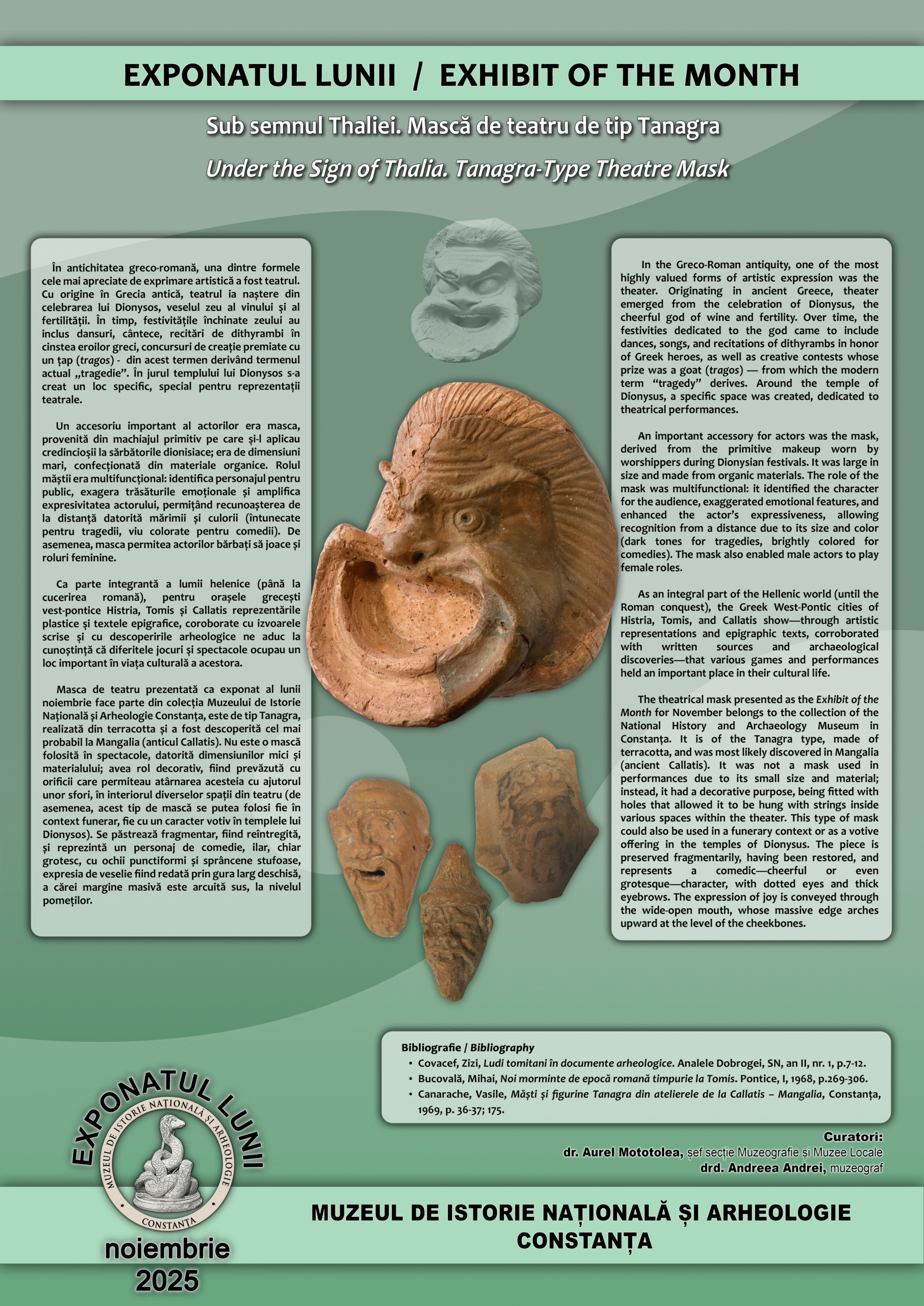
Masca de teatru prezentată ca exponat al lunii noiembrie face parte din colecția Muzeului de Istorie Națională și Arheologie Constanța, este de tip Tanagra, realizată din terracotta și a fost descoperită cel mai probabil la Mangalia (anticul Callatis). Nu este o mască folosită în spectacole, datorită dimensiunilor mici și materialului; avea rol decorativ, fiind prevăzută cu orificii care permiteau atârnarea acesteia cu ajutorul unor sfori, în interiorul diverselor spații din teatru (de asemenea, acest tip de mască se putea folosi fie în context funerar, fie cu un caracter votiv în templele lui Dionysos). Se păstrează fragmentar, fiind reîntregită, și reprezintă un personaj de comedie, ilar, chiar grotesc, cu ochii punctiformi și sprâncene stufoase, expresia de veselie fiind redată prin gura larg deschisă, a cărei margine masivă este arcuită sus, la nivelul pomeţilor.
Under the Sign of Thalia. Tanagra-Type Theatre Mask
In the Greco-Roman antiquity, one of the most highly valued forms of artistic expression was the theater. Originating in ancient Greece, theater emerged from the celebration of Dionysus, the cheerful god of wine and fertility. Over time, the festivities dedicated to the god came to include dances, songs, and recitations of dithyrambs in honor of Greek heroes, as well as creative contests whose prize was a goat (tragos) — from which the modern term “tragedy” derives. Around the temple of Dionysus, a specific space was created, dedicated to theatrical performances.
An important accessory for actors was the mask, derived from the primitive makeup worn by worshippers during Dionysian festivals. It was large in size and made from organic materials. The role of the mask was multifunctional: it identified the character for the audience, exaggerated emotional features, and enhanced the actor’s expressiveness, allowing recognition from a distance due to its size and color (dark tones for tragedies, brightly colored for comedies). The mask also enabled male actors to play female roles.
As an integral part of the Hellenic world (until the Roman conquest), the Greek West-Pontic cities of Histria, Tomis, and Callatis show—through artistic representations and epigraphic texts, corroborated with written sources and archaeological discoveries—that various games and performances held an important place in their cultural life.
The theatrical mask presented as the Exhibit of the Month for November belongs to the collection of the National History and Archaeology Museum in Constanța. It is of the Tanagra type, made of terracotta, and was most likely discovered in Mangalia (ancient Callatis). It was not a mask used in performances due to its small size and material; instead, it had a decorative purpose, being fitted with holes that allowed it to be hung with strings inside various spaces within the theater. This type of mask could also be used in a funerary context or as a votive offering in the temples of Dionysus. The piece is preserved fragmentarily, having been restored, and represents a comedic—cheerful or even grotesque—character, with dotted eyes and thick eyebrows. The expression of joy is conveyed through the wide-open mouth, whose massive edge arches upward at the level of the cheekbones.
Curatori:
dr. Aurel Mototolea, șef secție Muzeografie și Muzee Locale
drd. Andreea Andrei, muzeograf
Bibliografie / Bibliography
Covacef, Zizi, Ludi tomitani în documente arheologice. Analele Dobrogei, SN, an II, nr. 1, p.7-12.
Bucovală, Mihai, Noi morminte de epocă romană timpurie la Tomis. Pontice, I, 1968, p.269-306.
Canarache, Vasile, Măști și figurine Tanagra din atelierele de la Callatis – Mangalia, Constanța, 1969, p. 36-37; 175.